
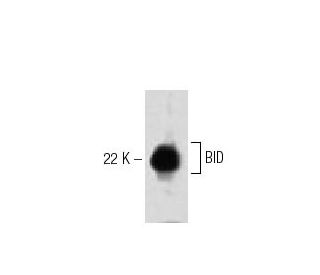

BID Antibody (40): sc-135847
- BID Antibody (40) is a mouse monoclonal IgG1, cited in 6 publications, provided at 50 µg/500 µl
- raised against amino acids 46-168 of BID of mouse origin
- recommended for detection of BID of mouse origin by WB and IP
- See BID (F-5): sc-515616 for BID antibody conjugates, including AC, HRP, FITC, PE, Alexa Fluor® 488, 594, 647, 680 and 790.
- At present, we have not yet completed the identification of the preferred secondary detection reagent(s) for BID Antibody (40). This work is in progress.

QUICK LINKS
SEE ALSO...
BID Antibody (40) is a mouse monoclonal IgG1 antibody that detects BID in mouse samples through western blotting (WB) and immunoprecipitation (IP) applications. BID, a crucial member of the Bcl-2 family, plays a significant role in the regulation of apoptosis, acting as a pro-apoptotic factor that can promote cell death in response to various cellular signals. BID′s importance lies in its ability to dimerize with anti-apoptotic proteins like Bcl-2 and Bcl-x, effectively counteracting their protective effects and facilitating the apoptotic process. The presence of a BH3 domain in BID is essential for this dimerization, allowing BID to interact with other proteins in the apoptotic pathway. BID is predominantly localized in the cytosol but can also be found in membrane fractions, highlighting BID′s dynamic role in cellular signaling. BID is highly expressed in the kidney and is also detectable in other tissues such as the brain, spleen, liver, testis, and lung, indicating BID′s widespread influence on cell survival and death across various biological contexts. Anti-BID antibody (40) is an invaluable tool for researchers studying apoptosis and its implications in health and disease.
Alexa Fluor® is a trademark of Molecular Probes Inc., OR., USA
LI-COR® and Odyssey® are registered trademarks of LI-COR Biosciences
BID Antibody (40) References:
- Bid acts on the permeability transition pore complex to induce apoptosis. | Zamzami, N., et al. 2000. Oncogene. 19: 6342-50. PMID: 11175349
- BID-D59A is a potent inducer of apoptosis in primary embryonic fibroblasts. | Sarig, R., et al. 2003. J Biol Chem. 278: 10707-15. PMID: 12519725
- Bid sensitizes apoptosis induced by chemotherapeutic drugs in hepatocellular carcinoma. | Miao, J., et al. 2004. Int J Oncol. 25: 651-9. PMID: 15289866
- Bid deficiency ameliorates ischemic renal failure and delays animal death in C57BL/6 mice. | Wei, Q., et al. 2006. Am J Physiol Renal Physiol. 290: F35-42. PMID: 16106037
- Regulation and pathological role of bid in ischemic acute kidney injury. | Wei, Q. and Dong, Z. 2007. Ren Fail. 29: 935-40. PMID: 18067037
- Bid and calpains cooperate to trigger oxaliplatin-induced apoptosis of cervical carcinoma HeLa cells. | Anguissola, S., et al. 2009. Mol Pharmacol. 76: 998-1010. PMID: 19713356
- Bid mediates anti-apoptotic COX-2 induction through the IKKbeta/NFkappaB pathway due to 5-MCDE exposure. | Luo, W., et al. 2010. Curr Cancer Drug Targets. 10: 96-106. PMID: 20088789
- Bid agonist regulates murine hepatocyte proliferation by controlling endoplasmic reticulum calcium homeostasis. | Ni, HM., et al. 2010. Hepatology. 52: 338-48. PMID: 20578150
- Bid-induced mitochondrial membrane permeabilization waves propagated by local reactive oxygen species (ROS) signaling. | Garcia-Perez, C., et al. 2012. Proc Natl Acad Sci U S A. 109: 4497-502. PMID: 22393005
- Bid premiums and cumulative abnormal returns: An empirical investigation on the consequences of the Covid-19 pandemic. | Magnanelli, BS., et al. 2022. Financ Res Lett. 49: 103093. PMID: 35789640
Ordering Information
| Product Name | Catalog # | UNIT | Price | Qty | FAVORITES | |
BID Antibody (40) | sc-135847 | 50 µg/500 µl | $322.00 |