
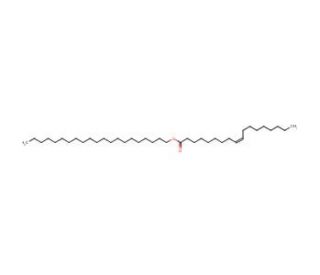

Behenyl oleate (CAS 127566-70-5)
LINK RAPIDI
L'oleato di behenile è un estere derivato dall'acido behenico e dall'acido oleico, ampiamente utilizzato nella ricerca per le sue proprietà uniche nella chimica dei lipidi e nella scienza dei materiali. Questo composto è noto per le sue caratteristiche emollienti e lubrificanti, che lo rendono oggetto di interesse negli studi relativi alle interazioni lipidiche e alla dinamica delle membrane. Nella ricerca biochimica, l'oleato di behenile viene spesso utilizzato per studiare il comportamento degli esteri a catena lunga nei bilayer lipidici, contribuendo alla comprensione della fluidità delle membrane, del comportamento di fase e dell'organizzazione dei microdomini lipidici. Le ricerche che coinvolgono il behenil oleato includono il suo ruolo di substrato per gli studi enzimatici. Viene utilizzato per esaminare l'attività e la specificità delle lipasi e delle esterasi, enzimi che catalizzano l'idrolisi dei legami esterici. Studiando il modo in cui questi enzimi interagiscono con l'oleato di behenile, i ricercatori acquisiscono conoscenze sul metabolismo dei lipidi e sui meccanismi che regolano la scomposizione e la sintesi dei lipidi complessi. Inoltre, l'oleato di behenile viene impiegato nella formulazione di vari materiali biocompatibili. La sua stabilità e le sue favorevoli proprietà fisico-chimiche lo rendono adatto allo sviluppo di sistemi di somministrazione a base lipidica e allo studio dell'incapsulamento e del rilascio di composti bioattivi. La capacità di questo composto di modificare le proprietà superficiali viene sfruttata anche nella scienza dei materiali per creare superfici e rivestimenti funzionalizzati. Nel complesso, l'oleato di behenile è uno strumento prezioso per la ricerca lipidomica e sui materiali, in grado di migliorare la comprensione delle interazioni lipidiche, dei processi enzimatici e dello sviluppo di materiali biocompatibili avanzati.
Behenyl oleate (CAS 127566-70-5) Referenze
- Valutazione e quantificazione degli esteri di cera intatti del meibum umano mediante gas-cromatografia liquida-spettrometria di massa a trappola ionica. | Butovich, IA., et al. 2012. Invest Ophthalmol Vis Sci. 53: 3766-81. PMID: 22531701
- Valutazione calorimetrica a scansione differenziale di secrezioni della ghiandola meibomiana umana e di miscele lipidiche modello: temperature di transizione e cooperatività della fusione. | Lu, H., et al. 2013. Chem Phys Lipids. 170-171: 55-64. PMID: 23578711
- Punti di fusione: la chiave dell'effetto anti-evaporativo degli esteri di cera del film lacrimale. | Rantamäki, AH., et al. 2013. Invest Ophthalmol Vis Sci. 54: 5211-7. PMID: 23833062
- Valutazione biofisica e morfologica del meibum dell'occhio umano normale e secco mediante microscopia a luce polarizzata a caldo. | Butovich, IA., et al. 2014. Invest Ophthalmol Vis Sci. 55: 87-101. PMID: 24282231
- Effetto dell'ozono ambientale sugli esteri di cera insaturi del film lacrimale. | Paananen, RO., et al. 2015. Invest Ophthalmol Vis Sci. 56: 8054-62. PMID: 26720456
- L'effetto dei fosfolipidi sull'attività di superficie dello strato lipidico del film lacrimale. | Rantamäki, AH. and Holopainen, JM. 2017. Invest Ophthalmol Vis Sci. 58: 149-154. PMID: 28114572
- Produzione di esteri di cera tramite sintesi microbica di olio da rifiuti e sottoprodotti dell'industria alimentare. | Papadaki, A., et al. 2017. Bioresour Technol. 245: 274-282. PMID: 28892702
- Proprietà antifungine degli esteri degli acidi grassi epidermici: Approfondimenti sulla sindrome del naso bianco (WNS) nei pipistrelli. | Frank, CL., et al. 2018. Molecules. 23: PMID: 30096918
- Lipasi batteriche e blefarite cronica. | Dougherty, JM. and McCulley, JP. 1986. Invest Ophthalmol Vis Sci. 27: 486-91. PMID: 3957566
Informazioni ordini
| Nome del prodotto | Codice del prodotto | UNITÀ | Prezzo | Quantità | Preferiti | |
Behenyl oleate, 50 mg | sc-214578 | 50 mg | $210.00 |