
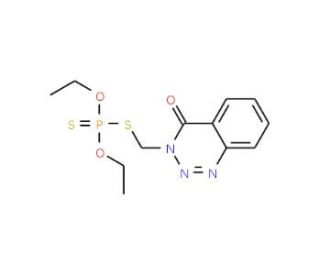

Azinphos-ethyl (CAS 2642-71-9)
QUICK LINKS
Azinphos-ethyl belongs to the organophosphorus family of insecticides and is characterized by colorless crystals. It is utilized as a non-systemic insecticide. This insecticide finds application in various crops. However, it is important to note that Azinphos-ethyl is not approved for use in the United States, as stated by the EPA in 1998. Azinphos-ethyl is an organothiophosphate insecticide and an organic thiophosphate compound. It functions as an acaricide, an inhibitor of acetylcholinesterase (EC 3.1.1.7), and an agrochemical. Its chemical structure derives from a hydride of a 1,2,3-benzotriazine. Azinphos-ethyl exerts its inhibitory effect on acetylcholinesterase activity in plasma, erythrocytes, brain, and submaxillary gland. Organophosphates and their potent sulfoxidation derivatives (′-oxon′ derivatives) act as inhibitors of the enzyme acetylcholinesterase, leading to the accumulation of excessive acetylcholine at muscarinic receptors (cholinergic effector cells), nicotinic receptors (skeletal neuromuscular junctions and autonomic ganglia), and in the central nervous system. Organophosphorus derivatives function by combining with and deactivating acetylcholinesterase (AChE), the enzyme responsible for hydrolyzing acetylcholine. The inhibition of cholinesterase by these pesticides leads to the accumulation of significant amounts of acetylcholine.
Azinphos-ethyl (CAS 2642-71-9) References
- Determination of Organophosphorus Pesticide Residues in Greek Virgin Olive Oil by Capillary Gas Chromatography. | Hiskia, AE., et al. 1998. J Agric Food Chem. 46: 570-574. PMID: 10554279
- Tyrosinase inhibition organic phase biosensor for triazinic and benzotriazinic pesticide analysis (part two). | Campanella, L., et al. 2006. Anal Bioanal Chem. 384: 915-21. PMID: 16328240
- Determination of pesticides by solid phase extraction followed by gas chromatography with nitrogen-phosphorous detection in natural water and comparison with solvent drop microextraction. | López-Blanco, C., et al. 2006. Anal Bioanal Chem. 384: 1002-6. PMID: 16402179
- Determination of eight selected organophosphorus insecticides in postmortem blood samples using solid-phase extraction and gas chromatography/mass spectrometry. | Raposo, R., et al. 2010. Rapid Commun Mass Spectrom. 24: 3187-94. PMID: 20941767
- Development of a solid-phase extraction coupling chemiluminescent enzyme immunoassay for determination of organophosphorus pesticides in environmental water samples. | Xu, ZL., et al. 2012. J Agric Food Chem. 60: 2069-75. PMID: 22329773
- Development of a broad-specificity monoclonal antibody-based immunoaffinity chromatography cleanup for organophosphorus pesticide determination in environmental samples. | Xu, ZL., et al. 2012. J Agric Food Chem. 60: 5847-52. PMID: 22612520
- Acute intoxication by azinphos-ethyl. | Marques, EG. 1990. J Anal Toxicol. 14: 243-6. PMID: 2395348
- Multiresidue method for simultaneous analysis of aflatoxin M1, avermectins, organophosphate pesticides and milbemycin in milk by ultra-performance liquid chromatography coupled to tandem mass spectrometry. | Dos Anjos, MR., et al. 2016. Food Addit Contam Part A Chem Anal Control Expo Risk Assess. 33: 995-1002. PMID: 27144891
- Ultrasound-assisted dispersive liquid-liquid microextraction followed by ion mobility spectrometry for the simultaneous determination of bendiocarb and azinphos-ethyl in water, soil, food and beverage samples. | Ghoraba, Z., et al. 2018. Ecotoxicol Environ Saf. 165: 459-466. PMID: 30218969
- Hyphenated dispersive solid- and liquid-phase microextraction technique based on a hydrophobic deep eutectic solvent: application for trace analysis of pesticides in fruit juices. | Sereshti, H., et al. 2020. J Sci Food Agric. 100: 2534-2543. PMID: 31975389
- Improved fully automated method for the determination of medium to highly polar pesticides in surface and groundwater and application in two distinct agriculture-impacted areas. | Barbieri, MV., et al. 2020. Sci Total Environ. 745: 140650. PMID: 32736100
- Occurrence and risk assessment of pesticides in a Mediterranean Basin with strong agricultural pressure (Guadiana Basin: Southern of Portugal). | Palma, P., et al. 2021. Sci Total Environ. 794: 148703. PMID: 34214808
- Applicability of a carbamate insecticide multiresidue method for determining additional types of pesticides in fruits and vegetables. | Krause, RT. and August, EM. 1983. J Assoc Off Anal Chem. 66: 234-40. PMID: 6853408
- Passive diffusion through polymeric membranes: a novel cleanup procedure for analysis of azinphos-methyl and azinphos-ethyl residues in fruits and vegetables. | Ahmad, N., et al. 1995. J AOAC Int. 78: 1450-4. PMID: 8664581
- Gas-liquid chromatographic determination of azinphos ethyl in human plasma and in mouse plasma, tissue, and fat. | Stein, VB. and Pittman, KA. 1976. J Assoc Off Anal Chem. 59: 1094-6. PMID: 965333
Ordering Information
| Product Name | Catalog # | UNIT | Price | Qty | FAVORITES | |
Azinphos-ethyl, 250 mg | sc-233900 | 250 mg | $57.00 |