
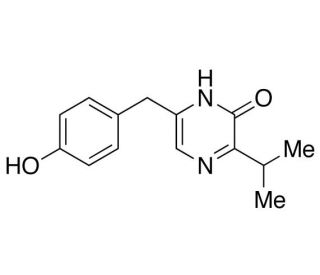

Aureusimine A (CAS 1244033-70-2)
QUICK LINKS
Aureusimine A is a novel compound discovered in the laboratory of Dr. Paul A. Wender at Stanford University in the early 2000s. It has been found to have a number of potential applications in laboratory experiments, including the synthesis of new compounds and the study of biochemical and physiological effects. In addition, Aureusimine A has been used in a number of studies to investigate the structure and function of proteins, as well as to study the effects of various compounds on cells and tissues. The fluorescent dye attached to the molecule binds to specific target molecules in the cell, allowing the molecule to be detected. This binding also triggers a cascade of biochemical reactions that lead to the desired effect.
Aureusimine A (CAS 1244033-70-2) References
- Staphylococcus aureus nonribosomal peptide secondary metabolites regulate virulence. | Wyatt, MA., et al. 2010. Science. 329: 294-6. PMID: 20522739
- Mutanobactin A from the human oral pathogen Streptococcus mutans is a cross-kingdom regulator of the yeast-mycelium transition. | Joyner, PM., et al. 2010. Org Biomol Chem. 8: 5486-9. PMID: 20852771
- Genomics-inspired discovery of natural products. | Winter, JM., et al. 2011. Curr Opin Chem Biol. 15: 22-31. PMID: 21111667
- Aureusimines in Staphylococcus aureus are not involved in virulence. | Sun, F., et al. 2010. PLoS One. 5: e15703. PMID: 21209955
- Phevalin (aureusimine B) production by Staphylococcus aureus biofilm and impacts on human keratinocyte gene expression. | Secor, PR., et al. 2012. PLoS One. 7: e40973. PMID: 22808288
- Heterologous expression and structural characterisation of a pyrazinone natural product assembly line. | Wyatt, MA., et al. 2012. Chembiochem. 13: 2408-15. PMID: 23070851
- Characterization of AusA: a dimodular nonribosomal peptide synthetase responsible for the production of aureusimine pyrazinones. | Wilson, DJ., et al. 2013. Biochemistry. 52: 926-37. PMID: 23302043
- Optimizing dimodular nonribosomal peptide synthetases and natural dipeptides in an Escherichia coli heterologous host. | Wyatt, MA. and Magarvey, NA. 2013. Biochem Cell Biol. 91: 203-8. PMID: 23859013
- Escherichia coli as a cell factory for heterologous production of nonribosomal peptides and polyketides. | Li, J. and Neubauer, P. 2014. N Biotechnol. 31: 579-85. PMID: 24704144
- Characterization of thermolide biosynthetic genes and a new thermolide from sister thermophilic fungi. | Niu, X., et al. 2014. Org Lett. 16: 3744-7. PMID: 24999817
- Nannozinones and sorazinones, unprecedented pyrazinones from myxobacteria. | Jansen, R., et al. 2014. J Nat Prod. 77: 2545-52. PMID: 25397992
- Staphylococcus aureus Exploits a Non-ribosomal Cyclic Dipeptide to Modulate Survival within Epithelial Cells and Phagocytes. | Blättner, S., et al. 2016. PLoS Pathog. 12: e1005857. PMID: 27632173
- Targeted and untargeted analysis of secondary metabolites to monitor growth and quorum sensing inhibition for methicillin-resistant Staphylococcus aureus (MRSA). | Jones, DD., et al. 2020. J Microbiol Methods. 176: 106000. PMID: 32649968
Ordering Information
| Product Name | Catalog # | UNIT | Price | Qty | FAVORITES | |
Aureusimine A, 2.5 mg | sc-503159A | 2.5 mg | $288.00 | |||
Aureusimine A, 5 mg | sc-503159 | 5 mg | $516.00 |