
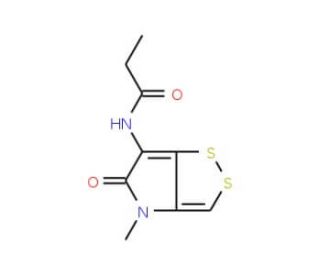

Aureothricin (CAS 574-95-8)
QUICK LINKS
Aureothricin is a natural antibiotic compound produced by certain strains of the bacterium Streptomyces thioluteus. It belongs to the thiopeptide class of antibiotics, characterized by their complex macrocyclic structures containing sulfur atoms, which are critical for their biological activity. The mechanism of action of aureothricin involves the inhibition of protein synthesis in susceptible bacteria by binding to the 23S rRNA of the 50S ribosomal subunit. This binding specifically disrupts the ribosomal function involved in the formation of peptide bonds, which are essential for linking amino acids during the process of translation. By interfering with this fundamental process, aureothricin effectively halts bacterial growth by preventing the synthesis of vital proteins. In research, aureothricin has been utilized as a tool to study bacterial ribosome structure and function, providing insights into the complex interactions between ribosomal components and antibiotics. Additionally, studies involving aureothricin have contributed to the understanding of the mechanisms of action and resistance of thiopeptide antibiotics. This research is invaluable in the broader context of microbial biochemistry and genetics, helping to explain how bacteria evolve resistance to antibiotics and how novel therapeutic strategies might be developed to counteract resistant bacterial strains.
Aureothricin (CAS 574-95-8) References
- Thiolutin, an inhibitor of HUVEC adhesion to vitronectin, reduces paxillin in HUVECs and suppresses tumor cell-induced angiogenesis. | Minamiguchi, K., et al. 2001. Int J Cancer. 93: 307-16. PMID: 11433393
- [Application of 13C-NMR to the biosynthetic investigations. III. Incorporation of propionate-3-13C into aureothricin (author's transl)]. | Yamazaki, M., et al. 1975. Yakugaku Zasshi. 95: 347-9. PMID: 1171186
- [On a yellow crystalline antibiotic, identical with aureothricin isolated from a new species of streptomyces, 39a, and its taxonomic study]. | NISHIMURA, H. and KIMURA, T. 1953. J Antibiot (Tokyo). 6: 57-65. PMID: 13084502
- Chemical studies on antibiotic substances. IV. A crystalline toxic substance of Streptomyces thioluteus producing aureothricin. | MAEDA, K. 1953. J Antibiot (Tokyo). 6: 137-8. PMID: 13096448
- IDENTIFICATION BY X-RAY POWDER DIFFRACTION OF THIOLUTIN AND AUREOTHRICIN ISOLATED BY PAPER CHROMATOGRAPHY. | MARTIN, JH., et al. 1963. Antimicrob Agents Chemother (Bethesda). 15: 130-3. PMID: 14275485
- Dithiolopyrrolone antibiotic formation induced by adding valeric acid to the culture broth of Saccharothrix algeriensis. | Merrouche, R., et al. 2010. J Nat Prod. 73: 1164-6. PMID: 20507156
- Regulation of biosynthesis of thiolutin and aureothricin in Streptomyces kasugaensis. | Sturdíková, M., et al. 1990. Folia Microbiol (Praha). 35: 278-83. PMID: 2262169
- Identification of an unusual type II thioesterase in the dithiolopyrrolone antibiotics biosynthetic pathway. | Zhai, Y., et al. 2016. Biochem Biophys Res Commun. 473: 329-335. PMID: 27018252
- [Biosynthesis and metabolic engineering of dithiolopyrrolone - A review]. | Huang, S. and Yu, Y. 2016. Wei Sheng Wu Xue Bao. 56: 383-96. PMID: 27382782
- Dithiolopyrrolones are Prochelators that are Activated by Glutathione. | Albini, F., et al. 2023. Chemistry. 29: e202202567. PMID: 36214647
- Inhibition of yeast ribonucleic acid polymerases by thiolutin. | Tipper, DJ. 1973. J Bacteriol. 116: 245-56. PMID: 4583213
- Mode of action of thiolutin, an inhibitor of macromolecular synthesis in Saccharomyces cerevisiae. | Jimenez, A., et al. 1973. Antimicrob Agents Chemother. 3: 729-38. PMID: 4597739
- Function of plasmids in the production of aureothricin. I. Elimination of plasmids and alteration of phenotypes caused by protoplast regeneration in Streptomyces kasugaensis. | Furumai, T., et al. 1982. J Antibiot (Tokyo). 35: 1367-73. PMID: 6757228
Ordering Information
| Product Name | Catalog # | UNIT | Price | Qty | FAVORITES | |
Aureothricin, 500 µg | sc-202069 | 500 µg | $294.00 |