
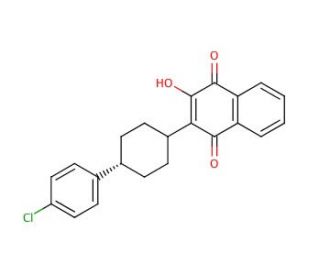

Atovaquone (CAS 95233-18-4)
See product citations (2)
QUICK LINKS
Atovaquone, a hydroxynaphthoquinone compound, is extensively used in scientific research to study its mechanism of inhibiting mitochondrial electron transport. Specifically, atovaquone targets the cytochrome b complex within the mitochondrial electron transport chain of fungi and protozoa, blocking the critical pathway for pyrimidine synthesis necessary for DNA replication. This selective inhibition makes it an invaluable tool for understanding the energy metabolism in protozoan organisms and offers a model for investigating mitochondrial dysfunctions. Its ability to disrupt the electron transport chain without affecting mammalian cells makes atovaquone particularly useful for comparative studies on the sensitivity and resistance mechanisms of different organisms to electron transport inhibitors. Research involving atovaquone also extends to its impact on the redox balance within cells, exploring how disruption of mitochondrial function influences cellular redox state, apoptosis, and other cell death mechanisms. These studies contribute to broader understanding in fields such as biochemistry and cell biology, providing insights into the fundamental processes that govern cellular energy production and the potential consequences of their disruption.
Atovaquone (CAS 95233-18-4) References
- Atovaquone and proguanil hydrochloride: a review of nonclinical studies. | Pudney, M., et al. 1999. J Travel Med. 6 Suppl 1: S8-12. PMID: 23573546
- Atovaquone Impairs Growth of Aspergillus and Fusarium Keratitis Isolates by Modulating Mitochondrial Function and Zinc Homeostasis. | Clark, HL., et al. 2018. Invest Ophthalmol Vis Sci. 59: 1589-1598. PMID: 29625485
- Atovaquone enhances doxorubicin's efficacy via inhibiting mitochondrial respiration and STAT3 in aggressive thyroid cancer. | Lv, Z., et al. 2018. J Bioenerg Biomembr. 50: 263-270. PMID: 29687367
- Atovaquone Inhibits Arbovirus Replication through the Depletion of Intracellular Nucleotides. | Cifuentes Kottkamp, A., et al. 2019. J Virol. 93: PMID: 30894466
- Atovaquone: An Antiprotozoal Drug Suppresses Primary and Resistant Breast Tumor Growth by Inhibiting HER2/β-Catenin Signaling. | Gupta, N. and Srivastava, SK. 2019. Mol Cancer Ther. 18: 1708-1720. PMID: 31270151
- Atovaquone Suppresses Triple-Negative Breast Tumor Growth by Reducing Immune-Suppressive Cells. | Gupta, N., et al. 2021. Int J Mol Sci. 22: PMID: 34068008
- Atovaquone and Berberine Chloride Reduce SARS-CoV-2 Replication In Vitro. | Rodriguez-Rodriguez, BA., et al. 2021. Viruses. 13: PMID: 34960706
- Atovaquone and Pibrentasvir Inhibit the SARS-CoV-2 Endoribonuclease and Restrict Infection In Vitro but Not In Vivo. | von Beck, T., et al. 2023. Viruses. 15: PMID: 37766247
- Atovaquone inhibits colorectal cancer metastasis by regulating PDGFRβ/NF-κB signaling pathway. | Liu, B., et al. 2023. BMC Cancer. 23: 1070. PMID: 37932661
- Atovaquone enhances antitumor efficacy of TCR-T therapy by augmentation of ROS-induced ferroptosis in hepatocellular carcinoma. | Chen, A., et al. 2024. Cancer Immunol Immunother. 73: 49. PMID: 38349553
Ordering Information
| Product Name | Catalog # | UNIT | Price | Qty | FAVORITES | |
Atovaquone, 10 mg | sc-217675 | 10 mg | $270.00 |