
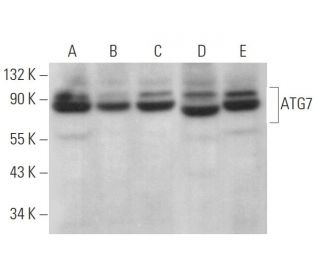
ATG7 Antibody (B-9): sc-376212
- ATG7 Antibody (B-9) is a mouse monoclonal IgG1 κ ATG7 antibody, cited in 58 publications, provided at 200 µg/ml
- raised against amino acids 1-300 mapping at the N-terminus of ATG7 of human origin
- ATG7 Antibody (B-9) is recommended for detection of ATG7 of mouse, rat and human origin by WB, IP, IF and ELISA
- Anti-ATG7 Antibody (B-9) is available conjugated to agarose for IP; HRP for WB, IHC(P) and ELISA; and to either phycoerythrin or FITC for IF, IHC(P) and FCM
- also available conjugated to Alexa Fluor® 488, Alexa Fluor® 546, Alexa Fluor® 594 or Alexa Fluor® 647 for WB (RGB), IF, IHC(P) and FCM, and for use with RGB fluorescent imaging systems, such as iBright™ FL1000, FluorChem™, Typhoon, Azure and other comparable systems
- also available conjugated to Alexa Fluor® 680 or Alexa Fluor® 790 for WB (NIR), IF and FCM; for use with Near-Infrared (NIR) detection systems, such as LI-COR®Odyssey®, iBright™ FL1000, FluorChem™, Typhoon, Azure and other comparable systems
- m-IgG1 BP-HRP is the preferred secondary detection reagent for ATG7 Antibody (B-9) for WB applications. This reagent is now offered in a bundle with ATG7 Antibody (B-9) (see ordering information below).

QUICK LINKS
ATG7 Antibody (B-9) is a mouse monoclonal IgG1 kappa light chain antibody that detects ATG7 of mouse, rat, and human origin by western blotting (WB), immunoprecipitation (IP), immunofluorescence (IF), and enzyme-linked immunosorbent assay (ELISA). ATG7 (B-9) antibody is available in both non-conjugated and various conjugated forms, including agarose, horseradish peroxidase (HRP), phycoerythrin (PE), fluorescein isothiocyanate (FITC), and multiple Alexa Fluor® conjugates. ATG7 plays a crucial role in the autophagy process, which is essential for cellular homeostasis and survival during nutrient deprivation. Located in the cytoplasm, ATG7 is involved in the conjugation of ATG5 to ATG12, a critical step in the formation of autophagosomes, which are membrane structures that engulf and degrade damaged organelles and proteins. This process not only helps in recycling cellular components but also plays a significant role in cellular response to stress and maintenance of cellular integrity. ATG7′s interaction with other autophagy-related proteins underscores its importance in regulating autophagy, making ATG7 a vital target for research in various diseases, including cancer and neurodegenerative disorders.
Alexa Fluor® is a trademark of Molecular Probes Inc., OR., USA
LI-COR® and Odyssey® are registered trademarks of LI-COR Biosciences
ATG7 Antibody (B-9) References:
- Apg7p/Cvt2p: A novel protein-activating enzyme essential for autophagy. | Tanida, I., et al. 1999. Mol Biol Cell. 10: 1367-79. PMID: 10233150
- m6A mRNA methylation controls autophagy and adipogenesis by targeting Atg5 and Atg7. | Wang, X., et al. 2020. Autophagy. 16: 1221-1235. PMID: 31451060
- atg7-Based Autophagy Activation Reverses Doxorubicin-Induced Cardiotoxicity. | Wang, Y., et al. 2021. Circ Res. 129: e166-e182. PMID: 34384247
- METTL3-mediated m6A modification of ATG7 regulates autophagy-GATA4 axis to promote cellular senescence and osteoarthritis progression. | Chen, X., et al. 2022. Ann Rheum Dis. 81: 87-99. PMID: 34706873
- Ablation of endothelial Atg7 inhibits ischemia-induced angiogenesis by upregulating Stat1 that suppresses Hif1a expression. | Yao, H., et al. 2023. Autophagy. 19: 1491-1511. PMID: 36300763
- Deacetylation of ATG7 drives the induction of macroautophagy and LC3-associated microautophagy. | Xu, Y., et al. 2024. Autophagy. 20: 1134-1146. PMID: 37999993
- Cytoplasm-to-vacuole targeting and autophagy employ the same machinery to deliver proteins to the yeast vacuole. | Scott, SV., et al. 1996. Proc Natl Acad Sci U S A. 93: 12304-8. PMID: 8901576
- Structural and functional analyses of APG5, a gene involved in autophagy in yeast. | Kametaka, S., et al. 1996. Gene. 178: 139-43. PMID: 8921905
- Nonclassical protein sorting to the yeast vacuole. | Klionsky, DJ. 1998. J Biol Chem. 273: 10807-10. PMID: 9556549
- Homology between a human apoptosis specific protein and the product of APG5, a gene involved in autophagy in yeast. | Hammond, EM., et al. 1998. FEBS Lett. 425: 391-5. PMID: 9563500
- A protein conjugation system essential for autophagy. | Mizushima, N., et al. 1998. Nature. 395: 395-8. PMID: 9759731
- A new protein conjugation system in human. The counterpart of the yeast Apg12p conjugation system essential for autophagy. | Mizushima, N., et al. 1998. J Biol Chem. 273: 33889-92. PMID: 9852036
Ordering Information
| Product Name | Catalog # | UNIT | Price | Qty | FAVORITES | |
ATG7 Antibody (B-9) | sc-376212 | 200 µg/ml | $322.00 | |||
ATG7 Antibody (B-9): m-IgG1 BP-HRP Bundle | sc-531715 | 200 µg Ab; 20 µg BP | $361.00 | |||
ATG7 Antibody (B-9) AC | sc-376212 AC | 500 µg/ml, 25% agarose | $424.00 | |||
ATG7 Antibody (B-9) HRP | sc-376212 HRP | 200 µg/ml | $322.00 | |||
ATG7 Antibody (B-9) FITC | sc-376212 FITC | 200 µg/ml | $336.00 | |||
ATG7 Antibody (B-9) PE | sc-376212 PE | 200 µg/ml | $349.00 | |||
ATG7 Antibody (B-9) Alexa Fluor® 488 | sc-376212 AF488 | 200 µg/ml | $364.00 | |||
ATG7 Antibody (B-9) Alexa Fluor® 546 | sc-376212 AF546 | 200 µg/ml | $364.00 | |||
ATG7 Antibody (B-9) Alexa Fluor® 594 | sc-376212 AF594 | 200 µg/ml | $364.00 | |||
ATG7 Antibody (B-9) Alexa Fluor® 647 | sc-376212 AF647 | 200 µg/ml | $364.00 | |||
ATG7 Antibody (B-9) Alexa Fluor® 680 | sc-376212 AF680 | 200 µg/ml | $364.00 | |||
ATG7 Antibody (B-9) Alexa Fluor® 790 | sc-376212 AF790 | 200 µg/ml | $364.00 |