
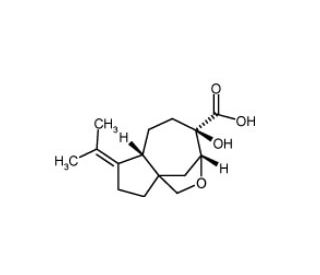

Molecular structure of Aspterric acid, CAS Number: 67309-95-9
Aspterric acid (CAS 67309-95-9)
Alternate Names:
2-(4-Methylphenyl)sulfonyl-5-nitrofuran
Application:
Aspterric acid is an antibiotic compound
CAS Number:
67309-95-9
Molecular Weight:
266.3
Molecular Formula:
C15H22O4
For Research Use Only. Not Intended for Diagnostic or Therapeutic Use.
* Refer to Certificate of Analysis for lot specific data.
QUICK LINKS
Ordering Information
Description
Technical Information
Safety Information
SDS & Certificate of Analysis
Aspterric acid, a sesquiterpene of the carotene type, is a natural product obtained from the fungus A. terreus. This compound acts as a plant growth regulator and a pollen development inhibitor. In A. thaliana, when applied at a concentration of 38 μM, it hampers pollen development, reduces stem length during initial flowering, and delays bolting and first flowering. Notably, aspterric acid influences the reproductive growth of A. thaliana without interfering with the biosynthesis and transportation of the plant growth regulator indole-3-acetic acid.
Aspterric acid (CAS 67309-95-9) References
- Aspterric acid and 6-hydroxymellein, inhibitors of pollen development in Arabidopsis thaliana, produced by Aspergillus terreus. | Shimada, A., et al. 2002. Z Naturforsch C J Biosci. 57: 459-64. PMID: 12132685
- Interaction between aspterric acid and indole-3-acetic acid on reproductive growth in Arabidopsis thaliana. | Shimada, A., et al. 2005. Z Naturforsch C J Biosci. 60: 572-6. PMID: 16163831
- The role of aspterric acid in auxin-regulated reproductive growth of Arabidopsis thaliana. | Shimada, A., et al. 2008. Z Naturforsch C J Biosci. 63: 554-6. PMID: 18811000
- Multi-mycotoxin screening reveals the occurrence of 139 different secondary metabolites in feed and feed ingredients. | Streit, E., et al. 2013. Toxins (Basel). 5: 504-23. PMID: 23529186
- Penicyrones A and B, an epimeric pair of α-pyrone-type polyketides produced by the marine-derived Penicillium sp. | Bu, YY., et al. 2016. J Antibiot (Tokyo). 69: 57-61. PMID: 26243556
- The Microbiome and Metabolites in Fermented Pu-erh Tea as Revealed by High-Throughput Sequencing and Quantitative Multiplex Metabolite Analysis. | Zhang, Y., et al. 2016. PLoS One. 11: e0157847. PMID: 27337135
- Chemical diversity from the Tibetan Plateau fungi Penicillium kongii and P. brasilianum. | Liu, ZG., et al. 2018. Mycology. 9: 10-19. PMID: 30123656
- Rhizosphere microorganisms can influence the timing of plant flowering. | Lu, T., et al. 2018. Microbiome. 6: 231. PMID: 30587246
- The active site of the Mycobacterium tuberculosis branched-chain amino acid biosynthesis enzyme dihydroxyacid dehydratase contains a 2Fe-2S cluster. | Bashiri, G., et al. 2019. J Biol Chem. 294: 13158-13170. PMID: 31315931
- Diverse bioactive metabolites from Penicillium sp. MMA derived from the red sea: structure identification and biological activity studies. | Boulis, AG., et al. 2020. Arch Microbiol. 202: 1985-1996. PMID: 32476047
- Cyanobacterial Dihydroxyacid Dehydratases Are a Promising Growth Inhibition Target. | Zhang, P., et al. 2020. ACS Chem Biol. 15: 2281-2288. PMID: 32786290
- Two new compounds from a mangrove sediment-derived fungus Penicillium polonicum H175. | Liu, SZ., et al. 2022. Nat Prod Res. 36: 2370-2378. PMID: 33146025
- Genome mining of secondary metabolites from a marine-derived Aspergillus terreus B12. | Du, X., et al. 2021. Arch Microbiol. 203: 5621-5633. PMID: 34459930
- Artemether and aspterric acid induce pancreatic alpha cells to transdifferentiate into beta cells in zebrafish. | Jia, J., et al. 2022. Br J Pharmacol. 179: 1962-1977. PMID: 34871457
- Dihydroxy-Acid Dehydratases From Pathogenic Bacteria: Emerging Drug Targets to Combat Antibiotic Resistance. | Bayaraa, T., et al. 2022. Chemistry. 28: e202200927. PMID: 35535733
Ordering Information
| Product Name | Catalog # | UNIT | Price | Qty | FAVORITES | |
Aspterric acid, 1 mg | sc-391099 | 1 mg | $255.00 |