
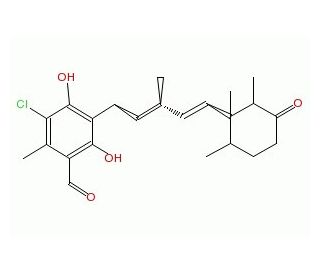

Ascochlorin (CAS 26166-39-2)
QUICK LINKS
Ascochlorin is an isoprenoid compound found in various strains of the fungus Ascochyta. In research applications, ascochlorin has been examined for its unique biological activities, such as its role as an inhibitor of mitochondrial complex III, a key component of the electron transport chain. This feature makes it a compound of interest in studies related to bioenergetics and mitochondrial function. Additionally, ascochlorin is used in studies probing the regulation of gene expression related to lipid metabolism, offering insights into the molecular mechanisms governing cellular lipid homeostasis. Its influence on immune response modulation is another avenue of investigation, which provides valuable information for understanding immune system dynamics.
Ascochlorin (CAS 26166-39-2) References
- Ascochlorin derivatives as ligands for nuclear hormone receptors. | Togashi, M., et al. 2003. J Med Chem. 46: 4113-23. PMID: 12954063
- Selective cytotoxicity of ascochlorin in ER-negative human breast cancer cell lines. | Sakaguchi, K., et al. 2005. Biochem Biophys Res Commun. 329: 46-50. PMID: 15721271
- Ascochlorin inhibits matrix metalloproteinase-9 expression by suppressing activator protein-1-mediated gene expression through the ERK1/2 signaling pathway: inhibitory effects of ascochlorin on the invasion of renal carcinoma cells. | Hong, S., et al. 2005. J Biol Chem. 280: 25202-9. PMID: 15863510
- Ascochlorin suppresses oxLDL-induced MMP-9 expression by inhibiting the MEK/ERK signaling pathway in human THP-1 macrophages. | Kang, JH., et al. 2007. J Cell Biochem. 102: 506-14. PMID: 17407144
- 4-O-methylascochlorin, methylated derivative of ascochlorin, stabilizes HIF-1α via AMPK activation. | Jeong, JH., et al. 2011. Biochem Biophys Res Commun. 406: 353-8. PMID: 21329651
- Ascochlorin inhibits growth factor-induced HIF-1α activation and tumor-angiogenesis through the suppression of EGFR/ERK/p70S6K signaling pathway in human cervical carcinoma cells. | Jeong, JH., et al. 2012. J Cell Biochem. 113: 1302-13. PMID: 22109717
- 4-O-carboxymethyl ascochlorin causes ER stress and induced autophagy in human hepatocellular carcinoma cells. | Kang, JH., et al. 2012. J Biol Chem. 287: 15661-71. PMID: 22433868
- Ascochlorin, an isoprenoid antibiotic inhibits growth and invasion of hepatocellular carcinoma by targeting STAT3 signaling cascade through the induction of PIAS3. | Dai, X., et al. 2015. Mol Oncol. 9: 818-33. PMID: 25624051
- Anti-Inflammatory Effect of Ascochlorin in LPS-Stimulated RAW 264.7 Macrophage Cells Is Accompanied With the Down-Regulation of iNOS, COX-2 and Proinflammatory Cytokines Through NF-κB, ERK1/2, and p38 Signaling Pathway. | Lee, SH., et al. 2016. J Cell Biochem. 117: 978-87. PMID: 26399466
- Ascochlorin Enhances the Sensitivity of Doxorubicin Leading to the Reversal of Epithelial-to-Mesenchymal Transition in Hepatocellular Carcinoma. | Dai, X., et al. 2016. Mol Cancer Ther. 15: 2966-2976. PMID: 27765853
- Ascochlorin Suppresses MMP-2-Mediated Migration and Invasion by Targeting FAK and JAK-STAT Signaling Cascades. | Cho, HJ., et al. 2018. J Cell Biochem. 119: 300-313. PMID: 28569433
- Complete biosynthetic pathways of ascofuranone and ascochlorin in Acremonium egyptiacum. | Araki, Y., et al. 2019. Proc Natl Acad Sci U S A. 116: 8269-8274. PMID: 30952781
Ordering Information
| Product Name | Catalog # | UNIT | Price | Qty | FAVORITES | |
Ascochlorin, 500 µg | sc-202066 | 500 µg | $373.00 |