
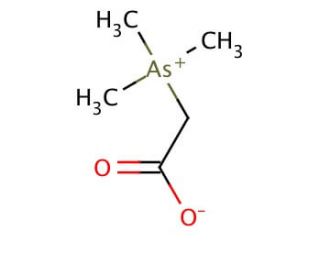

Struttura molecolare di Arsenobetaine, Numero CAS: 64436-13-1
Arsenobetaine (CAS 64436-13-1)
Nomi alternativi:
2-(Trimethylarsonio)acetate
Applicazione:
Arsenobetaine è una sostanza chimica utilizzata per studiare l'arsenico nella ricerca proteomica
Numero CAS:
64436-13-1
Purezza:
≥95%
Peso molecolare:
178.06
Formula molecolare:
C5H11AsO2
Informazioni supplementari:
Questo prodotto è classificato come merce pericolosa per il trasporto e potrebbe essere soggetto a spese di spedizione aggiuntive.
Solo per uso in Ricerca. Non previsto per Uso Diagnostico o Terapeutico.
* Vedere Certificato di Analisi per informazioni sul lotto specifico (incluso il contenuto d'acqua).
LINK RAPIDI
Informazioni ordini
Descrizione
Informazione tecnica
Informazioni di sicurezza
SDS & Certificato d'analisi
Nelle indagini scientifiche, la presenza dell'arsenobetaina nella vita marina viene utilizzata per esplorare gli impatti più ampi dei composti tossici dell'arsenico. La ricerca che coinvolge l'arsenobetaina comprende anche l'esame di come l'arsenico si accumula negli organismi acquatici e le sue successive vie di trasporto e metaboliche. Inoltre, gli studi che coinvolgono l'arsenobetaina contribuiscono a comprendere la traiettoria ambientale dell'arsenico negli ecosistemi marini. L'arsenobetaina si lega alle proteine cellulari e agli acidi nucleici, oltre a formare potenzialmente complessi con i gruppi sulfidrilici delle proteine.
Arsenobetaine (CAS 64436-13-1) Referenze
- Degradazione batterica dell'arsenobetaina tramite dimetilarsinoilacetato. | Jenkins, RO., et al. 2003. Arch Microbiol. 180: 142-50. PMID: 12827219
- Arsenobetaina nel salmone atlantico (Salmo salar L.): influenza dell'adattamento all'acqua di mare. | Amlund, H. and Berntssen, MH. 2004. Comp Biochem Physiol C Toxicol Pharmacol. 138: 507-14. PMID: 15536058
- Ritenzione cellulare, tossicità e potenziale cancerogeno dell'arsenico marino. I. Assenza di citotossicità e attività di trasformazione dell'arsenobetaina nella linea cellulare BALB/3T3. | Sabbioni, E., et al. 1991. Carcinogenesis. 12: 1287-91. PMID: 2070494
- Gli esseri umani sembrano produrre arsenobetaina e dimetilarsinato dopo una dose in bolo di frutti di mare. | Molin, M., et al. 2012. Environ Res. 112: 28-39. PMID: 22137101
- Contributo comparativo del trasferimento trofico e della biotrasformazione sul bioaccumulo di arsenobetaina in due pesci marini. | Zhang, W., et al. 2016. Aquat Toxicol. 179: 65-71. PMID: 27584085
- L'arsenobetaina: un organoarsenico importante dal punto di vista ecofisiologico conferisce citoprotezione contro lo stress osmotico e gli estremi della temperatura di crescita. | Hoffmann, T., et al. 2018. Environ Microbiol. 20: 305-323. PMID: 29159878
- Arsenobetaina in acqua di mare: Profili di profondità da siti selezionati nell'Atlantico settentrionale. | Glabonjat, RA., et al. 2018. Environ Sci Technol. 52: 522-530. PMID: 29232115
- Identificazione di specie ittiche alimentari dell'Artico per l'analisi di contaminanti antropogenici attraverso la geografia e la genetica. | Walker, VK., et al. 2020. Foods. 9: PMID: 33302601
- Biodegradazione dell'arsenobetaina ad arsenico inorganico regolata da microrganismi e metaboliti specifici nei topi. | Ye, Z., et al. 2022. Toxicology. 475: 153238. PMID: 35718002
- Geni chiave per la sintesi di arsenobetaina in medaka marini (Oryzias melastigma) mediante trascrittomica. | Ye, Z., et al. 2022. Aquat Toxicol. 253: 106349. PMID: 36395554
- Biotrasformazione significativa di arsenobetaina in arsenico inorganico nei topi. | Zhang, J., et al. 2023. Toxics. 11: PMID: 36850967
- Metabolismo dell'arsenobetaina in topi, ratti e conigli. | Vahter, M., et al. 1983. Sci Total Environ. 30: 197-211. PMID: 6648507
- L'arsenobetaina non è uno dei principali metaboliti del gas arsina nel ratto. | Buchet, JP., et al. 1998. Arch Toxicol. 72: 706-10. PMID: 9879808
Informazioni ordini
| Nome del prodotto | Codice del prodotto | UNITÀ | Prezzo | Quantità | Preferiti | |
Arsenobetaine, 50 mg | sc-227279 | 50 mg | $449.00 |