
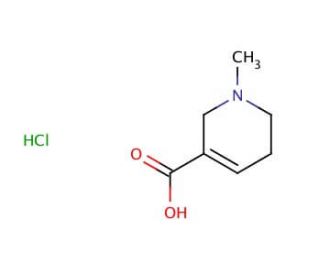

Arecaidine hydrochloride (CAS 6018-28-6)
QUICK LINKS
Arecaidine hydrochloride is a chemical that functions as an inhibitor of acetylcholinesterase, which is an enzyme responsible for breaking down the neurotransmitter acetylcholine. By inhibiting this enzyme, arecaidine hydrochloride increases the levels of acetylcholine in the synaptic cleft, leading to prolonged stimulation of cholinergic receptors. Arecaidine Hydrochloride′s mechanism of action involves binding to the active site of acetylcholinesterase, preventing it from catalyzing the hydrolysis of acetylcholine. As a result, arecaidine hydrochloride can modulate cholinergic neurotransmission and affect various physiological processes that involve acetylcholine signaling. In research and development, this chemical′s function as an acetylcholinesterase inhibitor can be utilized to study the role of acetylcholine in different biological systems.
Arecaidine hydrochloride (CAS 6018-28-6) References
- Dissociation constants of some compounds related to lysergic acid; Beta-dimethylaminopropionic acid, dihydroarecaidine, ecgonine and their derivatives. | CHILTON, J. and STENLAKE, JB. 1955. J Pharm Pharmacol. 7: 1004-11. PMID: 13278846
- Characterization of protein adducts formed by toxic alkaloids by nano-scale liquid chromatography with mass spectrometry. | Chou, CH., et al. 2012. J Mass Spectrom. 47: 1303-12. PMID: 23019161
- Regional brain metabolic responsivity to the muscarinic cholinergic agonist arecoline is similar in young and aged Fischer-344 rats. | Soncrant, TT., et al. 1989. Brain Res. 487: 255-66. PMID: 2731046
- Determination of contents of four alkaloids in Pericarpium arecae by quantitative analysis of multi-components by single-marker. | Yu, H., et al. 2016. Pak J Pharm Sci. 29: 1269-74. PMID: 27393441
- Quality assessment of crude and processed Arecae semen based on colorimeter and HPLC combined with chemometrics methods. | Sun, M., et al. 2017. J Sep Sci. 40: 2151-2160. PMID: 28371353
- Sub-chronic toxicity study of arecae semen aqueous extract in Wistar rats. | Lin, Q., et al. 2018. J Ethnopharmacol. 215: 176-183. PMID: 28847753
- Effects of Maerua subcordata (Gilg) DeWolf on electrophile-responsive element (EpRE)-mediated gene expression in vitro. | Gebrelibanos Hiben, M., et al. 2019. PLoS One. 14: e0215155. PMID: 30986264
- Testing for Betel Nut Alkaloids in Hair of Papuans Abusers using UPLC-MS/MS and UPLC-Q-Tof-MS. | Gheddar, L., et al. 2020. J Anal Toxicol. 44: 41-48. PMID: 31263904
- HPLC-Based Qualitative and Quantitative Analyses of Alkaloids in Chewable Areca Products from Different Geographic Regions. | Cao, M., et al. 2020. J AOAC Int. 103: 1400-1405. PMID: 33241395
- Oxidative Stress and Endoplasmic Reticulum Stress Contributes to Arecoline and Its Secondary Metabolites-Induced Dyskinesia in Zebrafish Embryos. | Yan, W., et al. 2023. Int J Mol Sci. 24: PMID: 37047326
- Mercapturic acid formation during the metabolism of arecoline and arecaidine in the rat. | Boyland, E. and Nery, R. 1969. Biochem J. 113: 123-30. PMID: 5806385
- Brain uptake of pipecolic acid, amino acids, amines following intracarotid injection in the mouse. | Nishio, H. and Giacobini, E. 1981. Neurochem Res. 6: 835-45. PMID: 6796898
- Uptake of piperidine and pipecolic acid by synaptosomes from mouse brain. | Nomura, Y., et al. 1980. Neurochem Res. 5: 1163-73. PMID: 7464982
Ordering Information
| Product Name | Catalog # | UNIT | Price | Qty | FAVORITES | |
Arecaidine hydrochloride, 100 mg | sc-233889 | 100 mg | $104.00 | |||
Arecaidine hydrochloride, 1 g | sc-233889A | 1 g | $520.00 |