
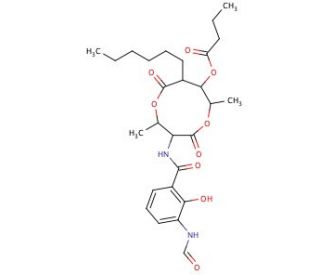

Antimycin A2 (CAS 27220-57-1)
See product citations (1)
QUICK LINKS
Antimycin A2, a member of the antimycin antibiotics, plays a pivotal role in biochemical research due to its specific action on the mitochondrial electron transport chain. Like its closely related counterpart, Antimycin A1, Antimycin A2 acts by binding to the Q_i site of cytochrome b within Complex III (the bc1 complex). This binding disrupts the electron transfer from ubiquinol to cytochrome c1, leading to a blockage in ATP synthesis by halting the proton gradient essential for oxidative phosphorylation. The consequence of this inhibition is not only a reduction in energy production but also an increase in the generation of reactive oxygen species (ROS) within cells. These properties make Antimycin A2 a valuable tool in the study of mitochondrial dysfunction and cellular metabolism. Researchers utilize it to understand better the mechanisms governing mitochondrial response to electron transport chain interruptions, including how cells adapt to changes in energy availability and manage oxidative stress. Moreover, Antimycin A2 has been used in studies exploring the regulation of apoptosis, providing insights into how mitochondrial impairment can influence cell death pathways, crucial for understanding various biological processes and disease states that involve mitochondrial anomalies.
Antimycin A2 (CAS 27220-57-1) References
- A single Streptomyces symbiont makes multiple antifungals to support the fungus farming ant Acromyrmex octospinosus. | Seipke, RF., et al. 2011. PLoS One. 6: e22028. PMID: 21857911
- Reconstitution of the anti-apoptotic Bcl-2 protein into lipid membranes and biophysical evidence for its detergent-driven association with the pro-apoptotic Bax protein. | Wallgren, M., et al. 2013. PLoS One. 8: e61452. PMID: 23626686
- The regulation and biosynthesis of antimycins. | Seipke, RF. and Hutchings, MI. 2013. Beilstein J Org Chem. 9: 2556-63. PMID: 24367419
- Reversible temperature-dependent differences in brown adipose tissue respiration during torpor in a mammalian hibernator. | McFarlane, SV., et al. 2017. Am J Physiol Regul Integr Comp Physiol. 312: R434-R442. PMID: 28077390
- A phylogenetic and evolutionary analysis of antimycin biosynthesis. | Joynt, R. and Seipke, RF. 2018. Microbiology (Reading). 164: 28-39. PMID: 29111964
- Regulation of Antimycin Biosynthesis Is Controlled by the ClpXP Protease. | Bilyk, B., et al. 2020. mSphere. 5: PMID: 32269155
- Protocol to profile the bioenergetics of organoids using Seahorse. | Ludikhuize, MC., et al. 2021. STAR Protoc. 2: 100386. PMID: 33778780
- Applications and Restrictions of Integrated Genomic and Metabolomic Screening: An Accelerator for Drug Discovery from Actinomycetes? | Krause, J. 2021. Molecules. 26: PMID: 34576921
- The Symbiotic Fungus Leucoagaricus gongylophorus (Möller) Singer (Agaricales, Agaricaceae) as a Target Organism to Control Leaf-Cutting Ants. | Araújo, S., et al. 2022. Insects. 13: PMID: 35447801
- Modulation of Cellular Levels of Adenosine Phosphates and Creatine Phosphate in Cultured Primary Astrocytes. | Karger, G., et al. 2024. Neurochem Res. 49: 402-414. PMID: 37855866
Ordering Information
| Product Name | Catalog # | UNIT | Price | Qty | FAVORITES | |
Antimycin A2, 500 µg | sc-391740 | 500 µg | $250.00 |