
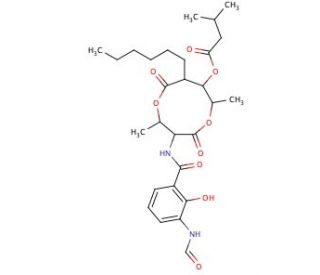

Antimycin A1 (CAS 642-15-9)
QUICK LINKS
Antimycin A1, a member of the antimycin family, is a potent inhibitor primarily known for its specific action on the mitochondrial electron transport chain. It acts at the bc1 complex (Complex III), where it binds to the Q_i site of cytochrome b, thereby preventing electron transfer from ubiquinol to cytochrome c1. This inhibition leads to a disruption in the proton gradient and, consequently, a halt in ATP synthesis via oxidative phosphorylation. Due to its ability to block electron flow and induce reactive oxygen species (ROS) production, Antimycin A1 has been extensively utilized in biochemical research to study cellular respiration, energy metabolism, and the mechanisms underlying ROS generation. Its role in inducing mitochondrial dysfunction makes it a valuable tool in investigations of cellular responses to mitochondrial stress and the regulation of apoptosis, independent of its potential implications in healthcare. Researchers have also exploited the unique properties of Antimycin A1 to explore the broader physiological roles of mitochondria in cellular signaling and adaptation to metabolic stress, providing insights that extend far beyond its initial characterization as an inhibitor of mitochondrial function.
Antimycin A1 (CAS 642-15-9) References
- Inhibition of angiogenesis and HIF-1alpha activity by antimycin A1. | Maeda, M., et al. 2006. Biol Pharm Bull. 29: 1344-8. PMID: 16819166
- Ginkgo extract EGb 761(®) shields from slowly accumulating neurodegenerative-like changes in a newly developed cell culture model induced by the combined action of low doses of antimycin A1 and 2-deoxy-D-glucose. | Plaschke, K., et al. 2011. J Neural Transm (Vienna). 118: 1247-54. PMID: 21479515
- Stage specific actions of antimalarial drugs on Plasmodium falciparum in culture. | Geary, TG., et al. 1989. Am J Trop Med Hyg. 40: 240-4. PMID: 2648881
- Arachidonic acid impairs the function of the blood-testis barrier via triggering mitochondrial complex-ROS-P38 MAPK axis in hyperthermal Sertoli cells. | Hu, Y., et al. 2023. Ecotoxicol Environ Saf. 252: 114598. PMID: 36774800
- Oxygen- and time-dependent effects of antibiotics and selected mitochondrial inhibitors on Plasmodium falciparum in culture. | Divo, AA., et al. 1985. Antimicrob Agents Chemother. 27: 21-7. PMID: 3885844
- Simple isolation of antimycin A1 and some of its toxicological properties. | Hamilton, PB., et al. 1969. Appl Microbiol. 17: 102-5. PMID: 5774751
- Kinetics and mechanism of hydrolysis of antimycin A1 in solution. | Hussain, A. 1969. J Pharm Sci. 58: 316-20. PMID: 5782023
- Mitochondria buffer physiological calcium loads in cultured rat dorsal root ganglion neurons. | Werth, JL. and Thayer, SA. 1994. J Neurosci. 14: 348-56. PMID: 8283242
- Mitochondrial regulation of store-operated calcium signaling in T lymphocytes. | Hoth, M., et al. 1997. J Cell Biol. 137: 633-48. PMID: 9151670
- Respiration and oxidative phosphorylation in the apicomplexan parasite Toxoplasma gondii. | Vercesi, AE., et al. 1998. J Biol Chem. 273: 31040-7. PMID: 9813002
Ordering Information
| Product Name | Catalog # | UNIT | Price | Qty | FAVORITES | |
Antimycin A1, 500 µg | sc-391456 | 500 µg | $306.00 |