
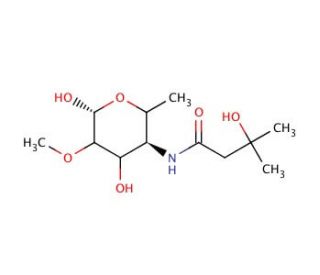

Anthrose (CAS 769959-88-8)
QUICK LINKS
Anthrose, a rare monosaccharide sugar, is primarily investigated in the context of microbial glycobiology and synthetic carbohydrate research. This sugar′s unique structure makes it a valuable subject for studying the biosynthesis and biological functions of unusual sugars found in bacterial glycans. In research settings, Anthrose is used to explore how bacteria incorporate rare sugars into their cell wall components, particularly in glycolipids and glycoproteins, which play crucial roles in microbial virulence, host-pathogen interactions, and immune evasion mechanisms. The chemical′s role extends into synthetic chemistry, where it serves as a building block for the synthesis of complex carbohydrates. This involves examining the enzymatic pathways that bacteria use to synthesize Anthrose, providing insights into the genetic and enzymatic machinery necessary for its production. Understanding these pathways can lead to advancements in the development of novel biosynthetic routes for carbohydrate production. Furthermore, Anthrose is utilized in the development of glycoconjugate vaccines where its incorporation into vaccine formulations is studied to enhance immunogenic responses against pathogenic bacteria. Researchers employ Anthrose to mimic bacterial surface structures, studying its potential to trigger specific immune responses in a controlled setting, thus contributing to the field of immunology and vaccine development strictly from a research perspective.
Anthrose (CAS 769959-88-8) References
- Synthesis and antigenic analysis of the BclA glycoprotein oligosaccharide from the Bacillus anthracis exosporium. | Mehta, AS., et al. 2006. Chemistry. 12: 9136-49. PMID: 17133642
- Anthrose biosynthetic operon of Bacillus anthracis. | Dong, S., et al. 2008. J Bacteriol. 190: 2350-9. PMID: 18245286
- Immuno-detection of anthrose containing tetrasaccharide in the exosporium of Bacillus anthracis and Bacillus cereus strains. | Tamborrini, M., et al. 2009. J Appl Microbiol. 106: 1618-28. PMID: 19226390
- Anthrax spore detection by a luminex assay based on monoclonal antibodies that recognize anthrose-containing oligosaccharides. | Tamborrini, M., et al. 2010. Clin Vaccine Immunol. 17: 1446-51. PMID: 20660139
- Characterization of the enzymes encoded by the anthrose biosynthetic operon of Bacillus anthracis. | Dong, S., et al. 2010. J Bacteriol. 192: 5053-62. PMID: 20675481
- Identification of an African Bacillus anthracis lineage that lacks expression of the spore surface-associated anthrose-containing oligosaccharide. | Tamborrini, M., et al. 2011. J Bacteriol. 193: 3506-11. PMID: 21571994
- Access to antigens related to anthrose using pivotal cyclic sulfite/sulfate intermediates. | Milhomme, O., et al. 2011. J Org Chem. 76: 5985-98. PMID: 21678952
- Nucleotide polymorphism assay for the identification of west African group Bacillus anthracis: a lineage lacking anthrose. | Zincke, D., et al. 2020. BMC Microbiol. 20: 6. PMID: 31910798
- Convergent evolution of diverse Bacillus anthracis outbreak strains toward altered surface oligosaccharides that modulate anthrax pathogenesis. | Norris, MH., et al. 2020. PLoS Biol. 18: e3001052. PMID: 33370274
- Beyond the spore, the exosporium sugar anthrose impacts vegetative Bacillus anthracis gene regulation in cis and trans. | Norris, MH., et al. 2023. Sci Rep. 13: 5060. PMID: 36977718
Ordering Information
| Product Name | Catalog # | UNIT | Price | Qty | FAVORITES | |
Anthrose, 1 mg | sc-210826 | 1 mg | $406.00 | |||
Anthrose, 2 mg | sc-210826A | 2 mg | $666.00 |