
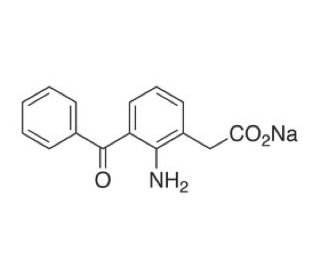

Amfenac Sodium Salt (CAS 61618-27-7)
QUICK LINKS
Amfenac Sodium Salt is extensively used in scientific studies focused on understanding the biochemistry of inflammatory processes. This chemical acts primarily as a nonsteroidal anti-inflammatory drug (NSAID) by selectively inhibiting cyclooxygenase (COX), an enzyme pivotal for the synthesis of prostaglandins, which are key mediators of inflammation. Research utilizing Amfenac Sodium Salt delves into the molecular pathways of COX inhibition, particularly examining its selectivity towards COX-2 over COX-1, which provides insights into the enzyme′s role in cellular responses to inflammatory stimuli. This specificity makes Amfenac an excellent tool for dissecting the role of prostaglandins in various biological processes, such as cell signaling and inflammation-induced gene expression. Studies often employ this compound in biochemical assays to explore its impact on prostaglandin levels within different cellular models, including its effects on prostaglandin-driven pathways that regulate pain signaling in neurons. Additionally, Amfenac Sodium Salt is used in comparative analyses of NSAID efficacy, helping to chart the landscape of enzyme inhibition and its downstream effects on cell behavior. This research contributes broadly to the fundamental understanding of cellular response mechanisms underpinning inflammation.
Amfenac Sodium Salt (CAS 61618-27-7) References
- Nepafenac, a unique nonsteroidal prodrug with potential utility in the treatment of trauma-induced ocular inflammation: I. Assessment of anti-inflammatory efficacy. | Gamache, DA., et al. 2000. Inflammation. 24: 357-70. PMID: 10850857
- Inhibitory effects of non-steroidal anti-inflammatory drugs on superoxide generation. | Yuda, Y., et al. 1991. Chem Pharm Bull (Tokyo). 39: 1075-7. PMID: 1654219
- Releasing Incisions Using Upward-Motion Scissors Technique for Flap Mobilization for Guided Bone Regeneration or Periodontal Surgery: Technical Introduction and a Case Report. | Inoko, M., et al. 2018. Int J Periodontics Restorative Dent. 38: 503-507. PMID: 29889913
- VITREOUS PROSTAGLANDIN E2 CHANGES AFTER TOPICAL ADMINISTRATION OF DICLOFENAC 0.1%, INDOMETHACIN 0.5%, NEPAFENAC 0.3%, AND BROMFENAC 0.09. | Pastore, MR., et al. 2020. Retina. 40: 1838-1845. PMID: 31800462
- Analgesic action of amfenac Na, a non-steroidal anti-inflammatory agent. | Hiranuma, T., et al. 1988. J Pharmacobiodyn. 11: 612-9. PMID: 3265150
- Interaction between warfarin and nonsteroidal anti-inflammatory drugs (NSAIDs) in rats. | Sancilio, LF., et al. 1985. Life Sci. 36: 1041-50. PMID: 3974406
- Toxicological studies on Amfenac sodium (AHR-5850) (I) Acute toxicities in mice and rats. | Sasaki, H., et al. 1984. J Toxicol Sci. 9: 87-99. PMID: 6471132
- Stimulation of myometrial and decidual prostaglandin production by amniotic fluid from term, but not midtrimester pregnancies. | Rehnstrŏm, J., et al. 1983. Prostaglandins. 26: 973-81. PMID: 6680924
- Oxytocin and the initiation of human parturition. II. Stimulation of prostaglandin production in human decidua by oxytocin. | Fuchs, AR., et al. 1981. Am J Obstet Gynecol. 141: 694-7. PMID: 7315896
- Simultaneous determination of amfenac sodium and its metabolite (7-benzoyl-2-oxindole) in human plasma by high-performance liquid chromatography. | Kato, Y., et al. 1993. J Chromatogr. 616: 67-71. PMID: 8376494
Ordering Information
| Product Name | Catalog # | UNIT | Price | Qty | FAVORITES | |
Amfenac Sodium Salt, 100 mg | sc-210793 | 100 mg | $250.00 |