
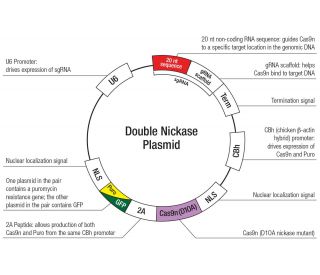


The Double Nickase Plasmid features a U6 promoter for sgRNA expression, a 20 nt targeting sequence, and a gRNA scaffold to guide Cas9n. It includes a CBh promoter for Cas9n (D10A) and puromycin resistance, GFP for transfection verification, and nuclear localization signals (NLS). The 2A peptide allows co-expression of Cas9n and Puro from a single promoter, enabling precise genome editing with reduced off-target effects.
α-actinin-3 Double Nickase Plasmid (h): sc-401486-NIC
- Zielspezies: human
- 20 µg transfektionsfertige, aufgereinigte Plasmid DNA; geeignet für 20 Transfektionen
- Das α-actinin-3 Double Nickase Plasmid (h) wird als Plasmid-Paar geliefert. Die einzelnen Plasmide kodieren für eine D10A mutierte Cas9 Nuklease sowie für je eine unterschiedliche, zielspezifische 20nt guide RNA (gRNA) Sequenz. Dies erlaubt eine hohe Knockout-Effizienz bei gleichzeitig größerer Spezifität als das entsprechende CRISPR/Cas9 KO Plasmid
- gRNA Sequenzpaare liegen ca. 20 bp auseinander um ein spezifisches Cas9-vermitteltes "Double Nicking" der genomischen DNA zu erlauben und so im Resultat den Effekt eines Doppelstrangbruchs nachzuahmen.
- Ein Plasmid kodiert für ein Puromycin-Resistenzgen zur Selektion von stabilen Knockout-Zellen. Das andere Plasmid kodiert für ein GFP-Gen für den visuellen Nachweis der Transfektion
- α-actinin-3 Double-Nickase-Plasmid (h) und α-actinin-3 Double-Nickase-Plasmid (h2) kodieren unterschiedliche gepaarte gRNA-Designs, die auf ACTN3 abzielen. Möglicherweise ist eines oder sind beide Designs verfügbar
- Nach der Transfektion kann die Effizienz des Gen-Knockouts per Western Blot oder histologisch mit folgendem Antikörper überprüft werden: α-actinin: sc-17829

Bestellinformation
| Produkt | Katalog # | EINHEIT | Preis | ANZAHL | Favoriten | |
α-actinin-3 Double Nickase Plasmid (h) | sc-401486-NIC | 20 µg | $410.00 | |||
α-actinin-3 Double Nickase Plasmid (h2) | sc-401486-NIC-2 | 20 µg | $410.00 |