
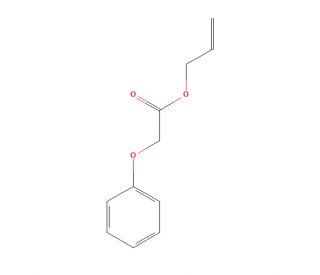

Molecular structure of Allyl Phenoxyacetate, CAS Number: 7493-74-5
Allyl Phenoxyacetate (CAS 7493-74-5)
Alternate Names:
Phenoxyacetic Acid Allyl Ester
CAS Number:
7493-74-5
Molecular Weight:
192.21
Molecular Formula:
C11H12O3
Supplemental Information:
This is classified as a Dangerous Good for transport and may be subject to additional shipping charges.
For Research Use Only. Not Intended for Diagnostic or Therapeutic Use.
* Refer to Certificate of Analysis for lot specific data.
QUICK LINKS
Ordering Information
Description
Technical Information
Safety Information
SDS & Certificate of Analysis
Allyl phenoxyacetate, a synthetic organic compound classified as a phenoxyacetic acid ester, exhibits properties that have led to its utilization as an inhibitor of cyclooxygenase-2 (COX-2). Furthermore, it has garnered attention for its potential as an antimicrobial agent. In laboratory experiments, Allyl phenoxyacetate has demonstrated the ability to impede the growth of cancer cells.
Allyl Phenoxyacetate (CAS 7493-74-5) References
- The effects of vehicles on the human dermal irritation potentials of allyl esters. | Politano, VT., et al. 2006. Int J Toxicol. 25: 183-93. PMID: 16717034
- A feasibility study developing an integrated testing strategy assessing skin irritation potential of chemicals. | Hoffmann, S., et al. 2008. Toxicol Lett. 180: 9-20. PMID: 18585875
- Assessment of the optimized SkinEthic Reconstructed Human Epidermis (RHE) 42 bis skin irritation protocol over 39 test substances. | Tornier, C., et al. 2010. Toxicol In Vitro. 24: 245-56. PMID: 19733227
- Extension of the Dermal Sensitisation Threshold (DST) approach to incorporate chemicals classified as reactive. | Safford, RJ., et al. 2015. Regul Toxicol Pharmacol. 72: 694-701. PMID: 25934255
- Property characterization of reconstructed human epidermis equivalents, and performance as a skin irritation model. | Capallere, C., et al. 2018. Toxicol In Vitro. 53: 45-56. PMID: 30053440
- In situ synthesis of a monolithic material with multi-sized pores and its chromatographic properties for the separation of intact proteins from human plasma. | Lan, D., et al. 2019. Talanta. 194: 406-414. PMID: 30609551
- Employment of cytology for in vitro skin irritation test using a reconstructed human epidermis model, Keraskin™. | Hwang, JH., et al. 2020. Toxicol In Vitro. 69: 104962. PMID: 32781017
- Expansion of the Cosmetics Europe skin sensitisation database with new substances and PPRA data. | Hoffmann, S., et al. 2022. Regul Toxicol Pharmacol. 131: 105169. PMID: 35447229
- Reference Chemical Potency List (RCPL): A new tool for evaluating the accuracy of skin sensitisation potency measurements by New Approach Methodologies (NAMs). | Irizar, A., et al. 2022. Regul Toxicol Pharmacol. 134: 105244. PMID: 35932886
- RIFM fragrance ingredient safety assessment, allyl phenoxyacetate, CAS Registry Number 7493-74-5. | Api, AM., et al. 2022. Food Chem Toxicol. 169 Suppl 1: 113470. PMID: 36252739
- Facial dermatitis from allyl phenoxyacetate in a dry carpet shampoo. | Taylor, AE. and Hindson, C. 1982. Contact Dermatitis. 8: 70. PMID: 7067443
- Trace detection of Ce3+ by adsorption strip voltammetry at a carbon paste electrode modified with ion imprinted polymers | Chen, J., Bai, H., Xia, J., Liu, X., & Liu, Y. 2018. Journal of Rare Earths. 36(10): 1121-1126.
- Molecularly imprinted polymer-carbon paste electrode (MIP-CPE)-based sensors for the sensitive detection of organic and inorganic environmental pollutants: A review. | Mostafiz, B., Bigdeli, S. A., Banan, K., Afsharara, H., Hatamabadi, D., Mousavi, P.,.. & Ghorbani-Bidkorbeh, F. 2021. Trends in Environmental Analytical Chemistry. 32: e00144.
Ordering Information
| Product Name | Catalog # | UNIT | Price | Qty | FAVORITES | |
Allyl Phenoxyacetate, 25 g | sc-472866 | 25 g | $74.00 |