
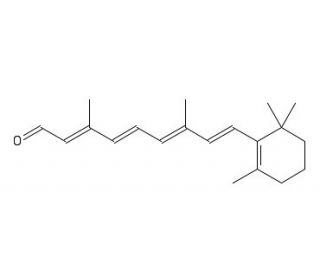

all-trans Retinal (CAS 116-31-4)
See product citations (7)
QUICK LINKS
All-trans retinal, a derivative of vitamin A, plays a pivotal role in the biochemistry of vision, acting as a key intermediate in the visual cycle. It functions by binding to opsin proteins in the photoreceptor cells of the retina, forming rhodopsin, which is essential for the conversion of light into electrical signals in the process of vision. Upon absorption of light, all-trans retinal isomerizes to its 11-cis form, initiating a cascade of biochemical events that result in a change in cell membrane potential and the transmission of nerve impulses to the brain. This property makes all-trans retinal invaluable in research focused on understanding the molecular basis of vision and the mechanics of phototransduction. Its role is also critical in the study of retinal diseases, offering insights into potential mechanisms for protecting against photoreceptor damage or degradation. Beyond vision, all-trans retinal is explored in the field of optogenetics, where it is used to control the activity of genetically modified neurons with light, providing a powerful tool for dissecting neural circuits and understanding brain function.
all-trans Retinal (CAS 116-31-4) References
- Identification and characterization of all-trans-retinol dehydrogenase from photoreceptor outer segments, the visual cycle enzyme that reduces all-trans-retinal to all-trans-retinol. | Rattner, A., et al. 2000. J Biol Chem. 275: 11034-43. PMID: 10753906
- Retinoid-binding proteins: mediators of retinoid action. | Noy, N. 2000. Biochem J. 348 Pt 3: 481-95. PMID: 10839978
- Studies on vitamin A: 5. The preparation of retinene(1)-vitamin A aldehyde. | Ball, S., et al. 1948. Biochem J. 42: 516-23. PMID: 16748320
- Retinopathy in mice induced by disrupted all-trans-retinal clearance. | Maeda, A., et al. 2008. J Biol Chem. 283: 26684-93. PMID: 18658157
- Involvement of all-trans-retinal in acute light-induced retinopathy of mice. | Maeda, A., et al. 2009. J Biol Chem. 284: 15173-83. PMID: 19304658
- Limited roles of Rdh8, Rdh12, and Abca4 in all-trans-retinal clearance in mouse retina. | Maeda, A., et al. 2009. Invest Ophthalmol Vis Sci. 50: 5435-43. PMID: 19553623
- Comparison of A2E cytotoxicity and phototoxicity with all-trans-retinal in human retinal pigment epithelial cells. | Wielgus, AR., et al. 2010. Photochem Photobiol. 86: 781-91. PMID: 20497365
- Key enzymes of the retinoid (visual) cycle in vertebrate retina. | Kiser, PD., et al. 2012. Biochim Biophys Acta. 1821: 137-51. PMID: 21447403
- Mechanism of all-trans-retinal toxicity with implications for stargardt disease and age-related macular degeneration. | Chen, Y., et al. 2012. J Biol Chem. 287: 5059-69. PMID: 22184108
- Reduction of all-trans-retinal in vertebrate rod photoreceptors requires the combined action of RDH8 and RDH12. | Chen, C., et al. 2012. J Biol Chem. 287: 24662-70. PMID: 22621924
- Tuning the electronic absorption of protein-embedded all-trans-retinal. | Wang, W., et al. 2012. Science. 338: 1340-3. PMID: 23224553
- Photoreceptor proteins initiate microglial activation via Toll-like receptor 4 in retinal degeneration mediated by all-trans-retinal. | Kohno, H., et al. 2013. J Biol Chem. 288: 15326-41. PMID: 23572532
- Retinal Pigment Epithelium Cell Death Is Associated With NLRP3 Inflammasome Activation by All-trans Retinal. | Liao, Y., et al. 2019. Invest Ophthalmol Vis Sci. 60: 3034-3045. PMID: 31311035
- Biotransformation of all-trans-retinol and all-trans-retinal to all-trans-retinoic acid in rat conceptal homogenates. | Chen, H., et al. 1995. Biochem Pharmacol. 50: 1257-64. PMID: 7488242
- Opsin/all-trans-retinal complex activates transducin by different mechanisms than photolyzed rhodopsin. | Jäger, S., et al. 1996. Biochemistry. 35: 2901-8. PMID: 8608127
- Reduction of all-trans-retinal limits regeneration of visual pigment in mice. | Saari, JC., et al. 1998. Vision Res. 38: 1325-33. PMID: 9667000
Ordering Information
| Product Name | Catalog # | UNIT | Price | Qty | FAVORITES | |
all-trans Retinal, 250 mg | sc-210778A | 250 mg | $129.00 | |||
all-trans Retinal, 1 g | sc-210778 | 1 g | $379.00 |