
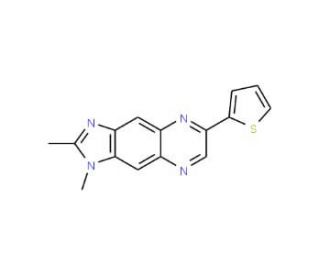

Estructura molecular de AGL 2043, Número CAS: 22617-28-8
AGL 2043 (CAS 22617-28-8)
Solicitud:
AGL 2043 es un compuesto permeable a las células que actúa como un potente inhibidor de las tirosina quinasas receptoras de tipo III
Número de CAS:
22617-28-8
Peso Molecular:
280.4
Fórmula Molecular:
C15H12N4S
Para Uso Exclusivo en Investigación. No está diseñado para uso en diagnosis o terapia.
* En el Certificado de Análisis específico de lote, puede encontrar información específica (como el contenido en agua).
ENLACES RÁPIDOS
Información sobre pedidos
Descripción
Información Técnica
Información de Seguridad
SDS & Certificado de Análisis
El AGL 2043 es un compuesto de quinoxalina tricíclico, permeable a las células, que actúa como inhibidor potente, selectivo, ATP-competitivo y reversible de las tirosina quinasas receptoras de tipo III, PDGFR (IC50 = 800 nM en células 3T3; 90 nM contra el receptor PDGFβ purificado), Flt3 y Kit (IC50 ~1-3 µM). Inhibe débilmente las quinasas PKA, EGFR, IGF-1R, VEGFR y Src (IC50 > 30 µM). Inhibe potentemente la proliferación de células musculares lisas y la estenosis inducida por globo en el corazón porcino.
AGL 2043 (CAS 22617-28-8) Referencias
- Quinoxalinas tricíclicas como potentes inhibidores de la quinasa PDGFR, Flt3 y Kit. | Gazit, A., et al. 2003. Bioorg Med Chem. 11: 2007-18. PMID: 12670652
- La tirfostina (AGL-2043) nanoencapsulada y administrada localmente reduce la formación de neoíntima en arterias carótidas de rata lesionadas con balón y arterias coronarias porcinas con stent. | Banai, S., et al. 2005. Biomaterials. 26: 451-61. PMID: 15275819
- El stent liberador de tirfosfostina AGL-2043 reduce la formación de neoíntima en arterias coronarias porcinas. | Banai, S., et al. 2004. Cardiovasc Res. 64: 165-71. PMID: 15364624
- Síntesis de imidazoquinoxalinonas asistida por microondas y sin trazas. | Lin, MJ. and Sun, CM. 2006. J Comb Chem. 8: 455-8. PMID: 16827554
- Entrega de grandes biofármacos desde stents cardiovasculares: una revisión. | Takahashi, H., et al. 2007. Biomacromolecules. 8: 3281-93. PMID: 17929968
- La liberación mediante stent de un bloqueante selectivo de los receptores PDGF de la clase del bis-indolilmetanon inhibe la reestenosis en el modelo animal del conejo. | Jandt, E., et al. 2010. Vascul Pharmacol. 52: 55-62. PMID: 19951743
- El stent liberador de nanopartículas con mesilato de imatinib incorporado atenúa la formación de neoíntima en el stent en arterias coronarias porcinas. | Masuda, S., et al. 2011. J Atheroscler Thromb. 18: 1043-53. PMID: 21996703
- Los elementos retrovirales endógenos relacionados con MuLV y Flt3 participan en eventos de end-joining aberrantes que promueven la leucemogénesis de células B. | Johnson, RM., et al. 2014. Genes Dev. 28: 1179-90. PMID: 24888589
- Avances recientes en implantes biomédicos a micro/nanoescala. | Arsiwala, A., et al. 2014. J Control Release. 189: 25-45. PMID: 24960225
- Nanocarriers for the Delivery of Quercetin to Inhibit the UV-Induced Aggregation of γD-Crystallin. | Goswami, V., et al. 2024. Langmuir. 40: 5617-5631. PMID: 38051761
Inhibidor de:
c-Kit, Enzyme, Flt-3/Flk-2, PDGFR-beta, y Tyrosine Kinase.Información sobre pedidos
| Nombre del producto | Número de catálogo | UNIDAD | Precio | CANTIDAD | Favoritos | |
AGL 2043, 1 mg | sc-203808 | 1 mg | $295.00 |