
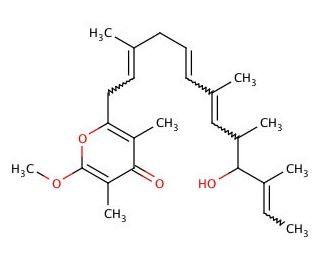

Actinopyrone A (CAS 88378-59-0)
QUICK LINKS
Actinopyrone A is a polyketide antibiotic produced by certain Streptomyces species, known for its distinctive structure and biological activity. The mechanism of action of actinopyrone A involves the inhibition of bacterial DNA synthesis. This compound binds to DNA and disrupts the activity of DNA gyrase and topoisomerase IV, essential enzymes for DNA replication and supercoiling. By interfering with these enzymes, actinopyrone A prevents the proper unwinding and replication of bacterial DNA, leading to cell death. This mode of action is particularly effective against a range of Gram-positive bacteria. In scientific research, actinopyrone A is utilized to study the molecular mechanisms of antibiotic action and resistance. Researchers employ this compound to investigate the interactions between antibiotics and their target enzymes, providing insights into the structural and functional aspects of DNA gyrase and topoisomerase IV. Additionally, actinopyrone A serves as a model compound for the development of new antibiotics, helping to explain the structure-activity relationships that determine efficacy and resistance. Actinopyrone A is also used in studies exploring the biosynthetic pathways of polyketides. Understanding the enzymatic steps and gene clusters involved in its production can lead to the discovery of new natural products with potential antibacterial properties. Furthermore, actinopyrone A′s role in biofilm disruption is investigated, as biofilms pose a significant challenge in both clinical and environmental contexts. Overall, actinopyrone A′s diverse applications in research contribute to advancing our understanding of bacterial DNA replication, antibiotic mechanisms, and the development of novel antimicrobial agents.
Actinopyrone A (CAS 88378-59-0) References
- MF-EA-705alpha & MF-EA-705beta, new metabolites from microbial fermentation of a Streptomyces sp. | Qureshi, A., et al. 2001. J Antibiot (Tokyo). 54: 1100-3. PMID: 11858667
- Total syntheses of polyketide-derived bioactive natural products. | Tatsuta, K. and Hosokawa, S. 2006. Chem Rec. 6: 217-33. PMID: 16900486
- Verticipyrone, a new NADH-fumarate reductase inhibitor, produced by Verticillium sp. FKI-1083. | Ui, H., et al. 2006. J Antibiot (Tokyo). 59: 785-90. PMID: 17323645
- Total synthesis of an anti-Helicobacter pylori agent, actinopyrone A. | Hosokawa, S., et al. 2008. Chem Asian J. 3: 1415-21. PMID: 18633953
- Gamma-pyrone natural products--a privileged compound class provided by nature. | Wilk, W., et al. 2009. Bioorg Med Chem. 17: 2304-9. PMID: 19042133
- Antitumor actinopyranones produced by Streptomyces albus POR-04-15-053 isolated from a marine sediment. | Schleissner, C., et al. 2011. J Nat Prod. 74: 1590-6. PMID: 21718029
- New Antimicrobial Phenyl Alkenoic Acids Isolated from an Oil Palm Rhizosphere-Associated Actinomycete, Streptomyces palmae CMU-AB204T. | Sujarit, K., et al. 2020. Microorganisms. 8: PMID: 32121612
- Luteapyrone, a Novel ƴ-Pyrone Isolated from the Filamentous Fungus Metapochonia lutea. | Labuda, R., et al. 2021. Molecules. 26: PMID: 34770997
- Characterization of the Glycosyltransferase and Methyltransferase Encoded Remotely from the Actinopyrone Biosynthetic Gene Cluster Enables Access to Diverse Analogues. | Zhang, H., et al. 2022. Org Lett. 24: 9065-9070. PMID: 36475912
Ordering Information
| Product Name | Catalog # | UNIT | Price | Qty | FAVORITES | |
Actinopyrone A, 500 µg | sc-202036 | 500 µg | $430.00 |