
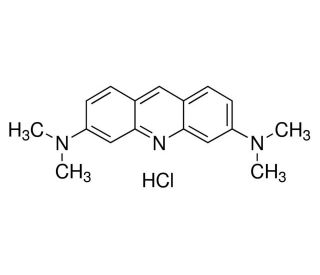

Acridine Orange solution (CAS 65-61-2)
See product citations (2)
QUICK LINKS
Acridine Orange solution is a fluorescent dye used extensively in the field of microscopy and cell biology. As a nucleic acid-selective dye, it intercalates into DNA and RNA, which allows researchers to visualize and distinguish between these biopolymers in cells and tissue sections. Research applications of Acridine Orange solution include the assessment of cell viability, where it can differentiate between live and dead cells based on differential staining patterns. It is also used in the quantification of nucleic acids in cell suspensions and the detection of chromosomal abnormalities. Additionally, Acridine Orange solution is instrumental in flow cytometry for the analysis of cell cycle status and apoptosis. Its role in the visualization of acidic cellular compartments, such as lysosomes, is also a key area of study, contributing to our understanding of cellular compartmentalization and function.
Acridine Orange solution (CAS 65-61-2) References
- Spectral changes accompanying binding of acridine orange by polyadenylic acid. | STEINER, RF. and BEERS, RF. 1958. Science. 127: 335-6. PMID: 13506582
- A simple fluorescent method for the detection of superficial fungi in skin and hair. A combined stain with acridine orange and potassium hydroxide. | CHICK, EW. and BEHAR, VS. 1961. J Invest Dermatol. 37: 103-5. PMID: 13693046
- [Research on the behavior of injected acridine orange solution in albino experimental animals with spontaneous and inoculated tumors]. | SCHICKER, H. 1962. Arch Geschwulstforsch. 18: 289-91. PMID: 14498335
- COMPETITIVE BINDING OF ATP AND ACRIDINE ORANGE BY MUSCLE. | Karreman, G., et al. 1957. Proc Natl Acad Sci U S A. 43: 373-9. PMID: 16590022
- Spermatozoa bound to solid state hyaluronic acid show chromatin structure with high DNA chain integrity: an acridine orange fluorescence study. | Yagci, A., et al. 2010. J Androl. 31: 566-72. PMID: 20133967
- Simple technique for fluorescence staining of blood cells with acridine orange. | Jahanmehr, SA., et al. 1987. J Clin Pathol. 40: 926-9. PMID: 2443542
- Using the vital dye acridine orange to detect dying cells in Drosophila. | Denton, D. and Kumar, S. 2015. Cold Spring Harb Protoc. 2015: 572-5. PMID: 26034308
- [Improvement of erythropoietin bioassay.]. | Yakovlev, AK., et al. 2018. Klin Lab Diagn. 63: 422-428. PMID: 30720958
- Photodynamic Surgery for Feline Injection-Site Sarcoma. | Martano, M., et al. 2019. Biomed Res Int. 2019: 8275935. PMID: 31360726
- Plasmid profiles and antibiotic susceptibility patterns of bacteria isolated from abattoirs wastewater within Ilorin, Kwara, Nigeria. | Olawale, SI., et al. 2020. Iran J Microbiol. 12: 547-555. PMID: 33613909
- Identification of malaria parasites by fluorescence microscopy and acridine orange staining. | Shute, GT. and Sodeman, TM. 1973. Bull World Health Organ. 48: 591-6. PMID: 4130021
- Acridine orange-epifluorescence technique for counting bacteria in natural waters. | Francisco, DE., et al. 1973. Trans Am Microsc Soc. 92: 416-21. PMID: 4581469
- Direct acridine orange fluorescence examination of blood slides compared to current techniques for malaria diagnosis. | Gay, F., et al. 1996. Trans R Soc Trop Med Hyg. 90: 516-8. PMID: 8944259
- [Studies on late replication bands of giant panda (Ailuropoda melanoleuca) chromosomes]. | Wang, YJ., et al. 1998. Yi Chuan Xue Bao. 25: 22-7. PMID: 9648401
Ordering Information
| Product Name | Catalog # | UNIT | Price | Qty | FAVORITES | |
Acridine Orange solution, 10 ml | sc-473594 | 10 ml | $166.00 |