
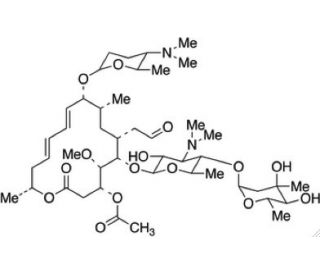

Acetyl Spiramycin の分子構造、CAS番号: 24916-51-6
Acetyl Spiramycin (CAS 24916-51-6)
アプリケーション:
Acetyl Spiramycinは、エリスロマイシン-カルボマイシン群に分類される抗生物質物質です
CAS 番号:
24916-51-6
純度:
95%
試験・研究用以外には使用しないでください。 臨床及び体外診断には使用できません。
* Refer to Certificate of Analysis for lot specific data.
クイックリンク
注文情報
説明
技術サポート情報
安全情報
SDSと分析証明書
「アセチルスピラマイシン」 とは、スピラマイシンの化学的にアセチル化された誘導体を指す。様々な細菌感染に効果的に対抗し、一般的にスピラマイシン、スピラマイシン酢酸エステル、またはスピラマイシンIと呼ばれている。その作用機序は、タンパク質合成を阻害することによって細菌の増殖と複製を阻害することである。これは50 Sリボソームサブユニット酵素に結合してペプチド結合を阻害し、最終的に細菌増殖を阻害することによって達成される。この化合物は,特にその親化合物と比較したその修飾された有効性と安定性の文脈において,その明確な生化学的性質と相互作用について研究されている。アセチル化は潜在的にその溶解度,分布および細菌標的との相互作用機構に影響し,種々の状況におけるその挙動と応用を理解するための生化学的および薬学的研究の興味の対象となっている。
Acetyl Spiramycin (CAS 24916-51-6) 参考文献
- スペインにおけるマクロライドの消費量とエリスロマイシンに対するStreptococcus pyogenesの耐性との関連(1986-1997年)。 | Granizo, JJ., et al. 2000. J Antimicrob Chemother. 46: 959-64. PMID: 11102415
- スピラマイシンで処理した培養ヒトリンパ球における染色体異常および姉妹染色分体交換の有意な増加は認められなかった。 | Rencüzoğullari, E., et al. 2002. Teratog Carcinog Mutagen. 22: 51-8. PMID: 11754387
- 供給バッチ発酵の制御。 | Lee, J., et al. 1999. Biotechnol Adv. 17: 29-48. PMID: 14538142
- 抗菌性マクロライド:複雑な薬理学的プロフィールを持つ薬物クラス。 | Abu-Gharbieh, E., et al. 2004. Pharmacol Res. 50: 211-22. PMID: 15225662
- Streptococcus mutansおよびStreptococcus sobrinusの1042株の抗菌薬感受性:1985年から1989年までの比較。 | Liebana, J., et al. 1991. Oral Microbiol Immunol. 6: 146-50. PMID: 1945497
- 加速溶媒抽出を用いた食肉中の17種類のマクロライド系抗生物質およびアベルメクチンの液体クロマトグラフィー-タンデム質量分析法による定量。 | Tao, Y., et al. 2012. J Chromatogr B Analyt Technol Biomed Life Sci. 897: 64-71. PMID: 22542398
- 中国深圳市の健康な被験者4500人における肺炎クラミジアと肺炎マイコプラズマの血清学的分析と薬剤耐性。 | Du, D., et al. 2017. Biomed Res Int. 2017: 3120138. PMID: 29057257
- トキソプラズマ・ゴンディ感染症に対する抗菌ペプチドHPRP-A1/A2の作用機序と効果に関する研究。 | Liu, R., et al. 2019. Parasite Immunol. 41: e12619. PMID: 30788848
- 日本産科婦人科学会ウィメンズヘルスケア委員会年報, 2019. | Kitawaki, J. and Kato, K. 2020. J Obstet Gynaecol Res. 46: 39-48. PMID: 31595599
- 迅速, 簡便, 安価, 効果的, 堅牢, 安全な抽出と超高速液体クロマトグラフィー四重極/静電場オービトラップ質量分析法を用いて, 牛乳中の25種類の一般的なマクロライドとともに6種類の新たな誘導体または代謝物をターゲット分析。 | Wang, J., et al. 2020. J Sep Sci. 43: 3719-3734. PMID: 32725879
- [アセチル-スピラマイシンの抗ブドウ球菌活性に関する実験的研究]。 | Kawamori, Y., et al. 1967. J Antibiot B. 20: 10-1. PMID: 5299296
- バッチプロセスにおける領域ファジィ制御 その2.抗生物質発酵生産プロセスにおけるフィードタイミング予測と制御 | FU, C. S., WANG, S. Q., & WANG, J. C. 1990. International journal of systems science. 21(10): 1911-1921.
- ラット骨髄細胞におけるスピラマイシンのin vivo遺伝毒性作用 | HB, I., & Topaktas, M. 1999. Cytologia. 64(3): 277-283.
注文情報
| 製品名 | カタログ # | 単位 | 価格 | 数量 | お気に入り | |
Acetyl Spiramycin, 50 mg | sc-217568 | 50 mg | $367.00 |