
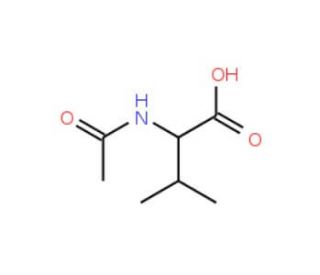

Ac-L-Val-OH (CAS 96-81-1)
QUICK LINKS
Ac-L-Val-OH is a naturally occurring amino acid present in most proteins and bears a structural resemblance to L-valine, one of the essential amino acids. This derivative of L-valine carries an acetyl group attached to its nitrogen atom. Its applications span a wide range, including protein synthesis, enzymatic reactions, and drug delivery. Over the years, Ac-L-Val-OH has been extensively studied in both in vitro and in vivo models, unveiling its potential significance in scientific research. In scientific research, Ac-L-Val-OH has proven its versatility with numerous applications. It has played a role in protein synthesis by acting as a substrate for peptide synthesis, incorporating into peptides via the formation of an amide bond. Furthermore, in enzymatic reactions, Ac-L-Val-OH has served as a substrate for various enzymes, including proteases and phosphatases. Although the precise mechanism of action of Ac-L-Val-OH remains somewhat elusive, it is believed to interact with proteins and other cellular molecules. Moreover, it can be broken down into smaller molecules, such as L-valine, which can be utilized for energy production. Additionally, Ac-L-Val-OH has demonstrated interactions with enzymes and other proteins, which may play a role in determining its mechanism of action. Ac-L-Val-OH holds promise in the realm of scientific investigation, offering a multifaceted tool with potential applications in protein synthesis, enzymatic reactions, and drug delivery. Despite some aspects yet to be fully understood, its impact in the field of research cannot be overlooked, inspiring further exploration of its possibilities.
Ac-L-Val-OH (CAS 96-81-1) References
- Enantioselective synthesis of planar chiral ferrocenes via palladium-catalyzed annulation with diarylethynes. | Shi, YC., et al. 2013. Beilstein J Org Chem. 9: 1891-6. PMID: 24062858
- Ligand-enabled cross-coupling of C(sp3)-H bonds with arylboron reagents via Pd(II)/Pd(0) catalysis. | Chan, KS., et al. 2014. Nat Chem. 6: 146-50. PMID: 24451591
- Enantioselective ortho-C-H cross-coupling of diarylmethylamines with organoborons. | Laforteza, BN., et al. 2015. Angew Chem Int Ed Engl. 54: 11143-6. PMID: 26242903
- P(O)R2-Directed Enantioselective C-H Olefination toward Chiral Atropoisomeric Phosphine-Olefin Compounds. | Li, SX., et al. 2017. Org Lett. 19: 1842-1845. PMID: 28358211
- Enantioselective γ-C(sp3)-H Activation of Alkyl Amines via Pd(II)/Pd(0) Catalysis. | Shao, Q., et al. 2018. J Am Chem Soc. 140: 5322-5325. PMID: 29629766
- Late stage modifications of P-containing ligands using transition-metal-catalysed C-H bond functionalisation. | Zhang, Z., et al. 2018. Chem Commun (Camb). 54: 7265-7280. PMID: 29774912
- Merging C(sp3)-H activation with DNA-encoding. | Fan, Z., et al. 2020. Chem Sci. 11: 12282-12288. PMID: 34094436
Ordering Information
| Product Name | Catalog # | UNIT | Price | Qty | FAVORITES | |
Ac-L-Val-OH, 5 g | sc-284898 | 5 g | $32.00 | |||
Ac-L-Val-OH, 25 g | sc-284898A | 25 g | $104.00 |