
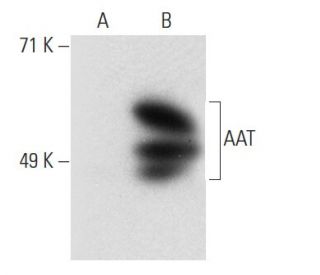

AAT Antibody (13702): sc-73431
- AAT Antibody (13702) is a mouse monoclonal IgG1, cited in 3 publications, provided at 100 µg/ml
- raised against alpha-1-antitrypsin of human origin
- recommended for detection of AAT of human origin by WB and IP; non cross-reactive with alpha-1-antichymotrypsin (AACT)
- At present, we have not yet completed the identification of the preferred secondary detection reagent(s) for AAT Antibody (13702). This work is in progress.

QUICK LINKS
SEE ALSO...
AAT Antibody (13702) is a mouse monoclonal IgG1 antibody that detects α1-antitrypsin (AAT) in human samples through applications such as western blotting (WB) and immunoprecipitation (IP). AAT is a crucial hepatic acute phase protein composed of 394 amino acids, primarily known for inhibiting Neutrophil Elastase, a protease that, when unchecked, contributes to pulmonary emphysema—a debilitating lung disease characterized by loss of elasticity in lung tissue. AAT is predominantly expressed in the liver and cultured hepatoma cells, with lower levels found in macrophages, highlighting AAT′s importance in the body′s response to inflammation and tissue damage. AAT is not only a highly polymorphic glycosylated serum protein but also exhibits distinct isoelectric-focusing patterns for various genetic variants, which can influence functional properties. The gene encoding AAT is located on human chromosome 14, in proximity to another serine protease inhibitor gene that encodes corticosteroid-binding globulin, indicating a complex regulatory network for protease inhibition. Post-translational modifications, such as oxidation of methionine 358 residue in AAT′s active site, can significantly impair AAT′s ability to inhibit elastase, underscoring the importance of maintaining structural integrity for effective protease regulation. AAT deficiency is linked to a 20-30 fold increased risk of developing early-onset pulmonary emphysema, making AAT study and interactions vital for understanding and potentially mitigating lung diseases.
Alexa Fluor® is a trademark of Molecular Probes Inc., OR., USA
LI-COR® and Odyssey® are registered trademarks of LI-COR Biosciences
AAT Antibody (13702) References:
- Molecular mechanisms of alpha1-antitrypsin null alleles. | Lee, JH. and Brantly, M. 2000. Respir Med. 94 Suppl C: S7-11. PMID: 10954248
- Oncostatin M induced alpha1-antitrypsin (AAT) gene expression in Hep G2 cells is mediated by a 3' enhancer. | Morgan, K., et al. 2002. Biochem J. 365: 555-60. PMID: 11936950
- Polymerisation underlies alpha1-antitrypsin deficiency, dementia and other serpinopathies. | Lomas, DA., et al. 2004. Front Biosci. 9: 2873-91. PMID: 15353322
- Molecular mousetraps, alpha1-antitrypsin deficiency and the serpinopathies. | Lomas, DA. 2005. Clin Med (Lond). 5: 249-57. PMID: 16011217
- Alpha1-antitrypsin protects beta-cells from apoptosis. | Zhang, B., et al. 2007. Diabetes. 56: 1316-23. PMID: 17360983
- Low Serum Alpha-1 Antitrypsin (AAT) in Family Members of Individuals with Autism Correlates with PiMZ Genotype. | Russo, AJ., et al. 2009. Biomark Insights. 4: 45-56. PMID: 19652762
- Effect of recombinant α1-antitrypsin Fc-fused (AAT-Fc)protein on the inhibition of inflammatory cytokine production and streptozotocin-induced diabetes. | Lee, S., et al. 2013. Mol Med. 19: 65-71. PMID: 23552726
- Circulating polymers in α1-antitrypsin deficiency. | Tan, L., et al. 2014. Eur Respir J. 43: 1501-4. PMID: 24603821
- Fibrinogen and α1-antitrypsin in COPD exacerbations. | Ingebrigtsen, TS., et al. 2015. Thorax. 70: 1014-21. PMID: 26304913
- Quantification of Murine AAT by Direct ELISA. | Cox, A. and Mueller, C. 2017. Methods Mol Biol. 1639: 217-222. PMID: 28752461
Ordering Information
| Product Name | Catalog # | UNIT | Price | Qty | FAVORITES | |
AAT Antibody (13702) | sc-73431 | 100 µg/ml | $322.00 |