
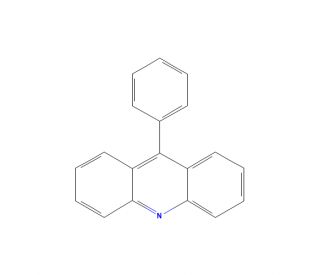

9-Phenylacridine (CAS 602-56-2)
QUICK LINKS
9-Phenylacridine, also known as 9-PA, is an aromatic heterocyclic compound found in a variety of plants. It is used in a variety of scientific research applications, including as a fluorescent dye, a fluorescent probe, and a fluorescent tag. It is also employed to study the structure and function of proteins, and to detect and quantify DNA and RNA. 9-Phenylacridine absorbs light in the visible region of the spectrum and emits light in the near-infrared region. The fluorescence is dependent on the pH of the solution, with the highest fluorescence occurring at pH 7.0. The fluorescence of 9-Phenylacridine can also be quenched by the presence of certain compounds, such as metal ions, amino acids, and nucleic acids.
9-Phenylacridine (CAS 602-56-2) References
- Carbon nanotube-acridine nanohybrids: spectroscopic characterization of photoinduced electron transfer. | Mackiewicz, N., et al. 2009. Chemistry. 15: 3882-8. PMID: 19229943
- 9-Phenyl-10H-acridinium trifluoro-methane-sulfonate. | Trzybiński, D., et al. 2010. Acta Crystallogr Sect E Struct Rep Online. 66: o2845-6. PMID: 21589031
- 9-phenyl acridine exhibits antitumour activity by inducing apoptosis in A375 cells. | Ghosh, R., et al. 2012. Mol Cell Biochem. 361: 55-66. PMID: 21964538
- Nanoparticle-based laser desorption/ionization mass spectrometric analysis of drugs and metabolites. | Chu, HW., et al. 2018. J Food Drug Anal. 26: 1215-1228. PMID: 30249320
- Synthesis, Molecular Recognition Study and Liquid Membrane-Based Applications of Highly Lipophilic Enantiopure Acridino-Crown Ethers. | Golcs, Á., et al. 2020. Molecules. 25: PMID: 32486509
- 9-phenyl acridine photosensitizes A375 cells to UVA radiation. | Hansda, S., et al. 2020. Heliyon. 6: e04733. PMID: 32944667
- Studies to explore the UVA photosensitizing action of 9-phenylacridine in cells by interaction with DNA. | Hansda, S., et al. 2021. Nucleosides Nucleotides Nucleic Acids. 40: 393-422. PMID: 33586599
- A novel photoredox-active group for the generation of fluorinated radicals from difluorostyrenes. | Zubkov, MO., et al. 2019. Chem Sci. 11: 737-741. PMID: 34123046
- Recent Advances in Visible-Light Photoredox Catalysis for the Thiol-Ene/Yne Reactions. | Xiao, Q., et al. 2022. Molecules. 27: PMID: 35163886
- A series of xanthenes inhibiting Rad6 function and Rad6-Rad18 interaction in the PCNA ubiquitination cascade. | Fenteany, G., et al. 2022. iScience. 25: 104053. PMID: 35355521
- A decennary update on applications of metal nanoparticles (MNPs) in the synthesis of nitrogen- and oxygen-containing heterocyclic scaffolds. | Dhameliya, TM., et al. 2020. RSC Adv. 10: 32740-32820. PMID: 35516511
- Acridine and Its Derivatives: Synthesis, Biological, and Anticorrosion Properties. | Goni, LKMO., et al. 2022. Materials (Basel). 15: PMID: 36363152
- Acridine as an Anti-Tumour Agent: A Critical Review. | Varakumar, P., et al. 2022. Molecules. 28: PMID: 36615391
Ordering Information
| Product Name | Catalog # | UNIT | Price | Qty | FAVORITES | |
9-Phenylacridine, 10 g | sc-484879 | 10 g | $235.00 |