
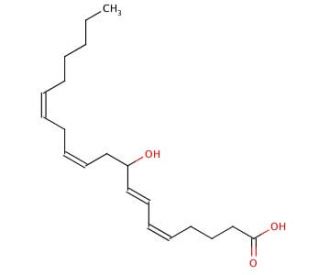

Molecular structure of (±)-9-HETE, CAS Number: 79495-85-5
(+/-)-9-HETE (CAS 79495-85-5)
Application:
(±)-9-HETE is a metabolite of arachidonic acid found to be a major product of lipid peroxidation in atherosclerotis
CAS Number:
79495-85-5
Molecular Weight:
320.47
Molecular Formula:
C20H32O3
Supplemental Information:
This is classified as a Dangerous Good for transport and may be subject to additional shipping charges.
For Research Use Only. Not Intended for Diagnostic or Therapeutic Use.
* Refer to Certificate of Analysis for lot specific data.
QUICK LINKS
Ordering Information
Description
Technical Information
Safety Information
SDS & Certificate of Analysis
(±)-9-HETE: Metabolism of free radical-mediated arachidonic acid oxidation forms 9-HETE. It is observed in placque and is found to be a major product of lipid peroxidation in atherosclerotis.
(+/-)-9-HETE (CAS 79495-85-5) References
- Systemic elevations of free radical oxidation products of arachidonic acid are associated with angiographic evidence of coronary artery disease. | Shishehbor, MH., et al. 2006. Free Radic Biol Med. 41: 1678-83. PMID: 17145556
- Inhibition of long-chain acyl-CoA synthetase 4 facilitates production of 5, 11-dihydroxyeicosatetraenoic acid via the cyclooxygenase-2 pathway. | Kuwata, H. and Hara, S. 2015. Biochem Biophys Res Commun. 465: 528-33. PMID: 26282205
- Relationship between metabolites of arachidonic acid and prognosis in patients with acute coronary syndrome. | Zu, L., et al. 2016. Thromb Res. 144: 192-201. PMID: 27393924
- Comparison of derivatization/ionization techniques for liquid chromatography tandem mass spectrometry analysis of oxylipins. | Meckelmann, SW., et al. 2017. Prostaglandins Other Lipid Mediat. 130: 8-15. PMID: 28215784
- Generation of the arachidonic acid metabolite 8-HETE by extracts of mouse skin treated with phorbol ester in vivo; identification by 1H-n.m.r. and GC-MS spectroscopy. | Gschwendt, M., et al. 1986. Carcinogenesis. 7: 449-55. PMID: 3081276
- Effects of aged stored autologous red blood cells on human plasma metabolome. | D'Alessandro, A., et al. 2019. Blood Adv. 3: 884-896. PMID: 30890545
- Arachidonic acid metabolism in a cloned strain of rat pituitary tumor cells: correlation between 15 hydroxyeicosatetraenoic acid release and the prolactin secretory process. | Rabier, M., et al. 1987. Prostaglandins Leukot Med. 27: 27-42. PMID: 3108904
- Association of Arachidonic Acid-derived Lipid Mediators with Subsequent Onset of Acute Myocardial Infarction in Patients with Coronary Artery Disease. | Huang, CC., et al. 2020. Sci Rep. 10: 8105. PMID: 32415198
- Stability of oxylipins during plasma generation and long-term storage. | Koch, E., et al. 2020. Talanta. 217: 121074. PMID: 32498891
- Red blood cell transfusion-related eicosanoid profiles in intensive care patients-A prospective, observational feasibility study. | Raeven, P., et al. 2023. Front Physiol. 14: 1164926. PMID: 37008004
- Biosynthesis of prostaglandins and hydroxy fatty acids in primary squamous carcinomas of head and neck in humans. | el Attar, TM., et al. 1985. Cancer Lett. 27: 255-9. PMID: 3926297
- The relationship of hydroxyeicosatetraenoic acids and F2-isoprostanes to plaque instability in human carotid atherosclerosis. | Mallat, Z., et al. 1999. J Clin Invest. 103: 421-7. PMID: 9927504
Ordering Information
| Product Name | Catalog # | UNIT | Price | Qty | FAVORITES | |
(+/-)-9-HETE, 50 µg | sc-200941 | 50 µg | $255.00 |