
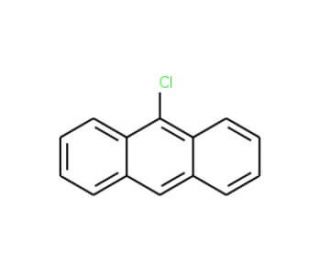

9-Chloroanthracene (CAS 716-53-0)
QUICK LINKS
9-Chloroanthracene, a polycyclic aromatic hydrocarbon (PAH). This white solid exhibits a melting point of approximately 106°C and a boiling point of around 250°C. While insoluble in water, it readily dissolves in various organic solvents. Serving as a intermediate in compound synthesis, 9-Chloroanthracene has found utility in investigating biochemical effects, as well as facilitating the synthesis of diverse compounds. The precise mechanism by which 9-Chloroanthracene operates remains incompletely understood. Nonetheless, it is hypothesized to interact with DNA and other cellular components, leading to the generation of reactive oxygen species (ROS). These ROS have the potential to induce oxidative damage in cells, ultimately resulting in cell death. Additionally, 9-Chloroanthracene has demonstrated the ability to interact with proteins and lipids, thereby influencing their structure and function.
9-Chloroanthracene (CAS 716-53-0) References
- Polycyclic aromatic hydrocarbons with bay-like regions inhibited gap junctional intercellular communication and stimulated MAPK activity. | Rummel, AM., et al. 1999. Toxicol Sci. 49: 232-40. PMID: 10416268
- Desipramine and fluoxetine antagonized 5,7-dihydroxytryptamine-induced lesion on rat hippocampal and cortical neurons. | Zhang, FQ., et al. 1999. Zhongguo Yao Li Xue Bao. 20: 889-92. PMID: 11270986
- 5,7-Dihydroxytryptamine: regional brain concentrations following intraventricular administration to rats. | Choi, SJ., et al. 2001. Neurochem Res. 26: 1145-9. PMID: 11700957
- Effects of 5,7-dihydroxytryptamine lesion of the dorsal raphe nucleus on the antidepressant-like action of tramadol in the unpredictable chronic mild stress in mice. | Yalcin, I., et al. 2008. Psychopharmacology (Berl). 200: 497-507. PMID: 18581097
- 2,5-Dimethyl-2,4-hexadiene induced photodechlorination of 9,10-dichloroanthracene. | Saltiel, J., et al. 2009. Photochem Photobiol Sci. 8: 856-67. PMID: 19492114
- Design and applications of an in situ electrochemical NMR cell. | Zhang, X. and Zwanziger, JW. 2011. J Magn Reson. 208: 136-47. PMID: 21067948
- Monitoring electrochemical reactions in situ using steady-state free precession (13)C NMR spectroscopy. | Nunes, LM., et al. 2014. Anal Chim Acta. 850: 1-5. PMID: 25441154
- [Intraventricular injection of 5,7-dihydroxytryptamine alters neuronal activity of neurons in the medial prefrontal cortex of rat]. | Fan, LL., et al. 2014. Sheng Li Xue Bao. 66: 667-74. PMID: 25516515
- Alterations in serotonin binding sites after 5,7-dihydroxytryptamine treatment in the rat spinal cord. | Brown, LM., et al. 1989. Neurosci Lett. 102: 103-7. PMID: 2779841
- The aryl hydrocarbon receptor (AhR) activity and DNA-damaging effects of chlorinated polycyclic aromatic hydrocarbons (Cl-PAHs). | Huang, C., et al. 2018. Chemosphere. 211: 640-647. PMID: 30098559
- Chlorinated Polycyclic Aromatic Hydrocarbons Induce Immunosuppression in THP-1 Macrophages Characterized by Disrupted Amino Acid Metabolism. | Li, X., et al. 2022. Environ Sci Technol. 56: 16012-16023. PMID: 36282008
- Rostral hypothalamic microinfusions of 5,7 dihydroxytryptamine produce anatomically and neurochemically selective depletions of hippocampal serotonin and increase the influence of estrogen and food deprivation on locomotor activity. | Waldbillig, RJ., et al. 1985. Brain Res. 347: 149-53. PMID: 4052795
- Increased behavioural response to 5-methoxy-N,N-dimethyltryptamine but not to RU-24969 after intraventricular 5,7-dihydroxytryptamine administration. | Nisbet, AP. and Marsden, CA. 1984. Eur J Pharmacol. 104: 177-80. PMID: 6499914
- Effects of 5,7-dihydroxytryptamine on HRP retrograde transport from hippocampus to midbrain raphe nuclei in the rat. | Zhou, FC. and Azmitia, EC. 1983. Brain Res Bull. 10: 445-51. PMID: 6860973
- Quantitative RT-PCR distribution of serotonin 5-HT6 receptor mRNA in the central nervous system of control or 5,7-dihydroxytryptamine-treated rats. | Gérard, C., et al. 1996. Synapse. 23: 164-73. PMID: 8807744
Ordering Information
| Product Name | Catalog # | UNIT | Price | Qty | FAVORITES | |
9-Chloroanthracene, 5 g | sc-352985 | 5 g | $250.00 | |||
9-Chloroanthracene, 25 g | sc-352985A | 25 g | $936.00 |