
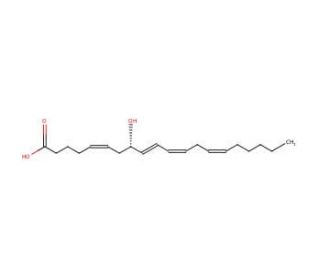

Molecular structure of 8(S)-HETE, CAS Number: 98462-03-4
8(S)-HETE (CAS 98462-03-4)
Alternate Names:
8(S-hydroxy-(5Z, 9E, 11Z, 14Z)-eicosatetraenoic acid
Application:
8(S)-HETE is a fatty acid metabolite and potential PKC and PPARα activator
CAS Number:
98462-03-4
Molecular Weight:
320.47
Molecular Formula:
C20H32O3
Supplemental Information:
This is classified as a Dangerous Good for transport and may be subject to additional shipping charges.
For Research Use Only. Not Intended for Diagnostic or Therapeutic Use.
* Refer to Certificate of Analysis for lot specific data.
QUICK LINKS
Ordering Information
Description
Technical Information
Safety Information
SDS & Certificate of Analysis
8(S)-HETE is a polyunsaturated fatty acid chemotactic for neutrophils and an intermediate in the synthesis of the family of eicosanoids known as leukotrienes. The compound has been observed to be biosynthesized in human neutrophils, phorbol ester-treated mouse epidermis and by hepatic microsomal cytochrome P-4503. 8(S)-HETE has been observed to regulate epithelial cell migration in the rat cornea. The compound has also been recognized as the key component of arachidonic acid in corneal wound healing.
8(S)-HETE (CAS 98462-03-4) References
- Oxidized phospholipids activate PPARalpha in a phospholipase A2-dependent manner. | Delerive, P., et al. 2000. FEBS Lett. 471: 34-8. PMID: 10760508
- 8(S)-hydroxyeicosatetraenoic acid is the lipoxygenase metabolite of arachidonic acid that regulates epithelial cell migration in the rat cornea. | Yamada, M. and Proia, AD. 2000. Cornea. 19: S13-20. PMID: 10832716
- Identification of a novel human eicosanoid receptor coupled to G(i/o). | Hosoi, T., et al. 2002. J Biol Chem. 277: 31459-65. PMID: 12065583
- Oxidized omega-3 fatty acids in fish oil inhibit leukocyte-endothelial interactions through activation of PPAR alpha. | Sethi, S., et al. 2002. Blood. 100: 1340-6. PMID: 12149216
- EPA and DHA reduce LPS-induced inflammation responses in HK-2 cells: evidence for a PPAR-gamma-dependent mechanism. | Li, H., et al. 2005. Kidney Int. 67: 867-74. PMID: 15698426
- Characterization of an 8-lipoxygenase activity induced by the phorbol ester tumor promoter 12-O-tetradecanoylphorbol-13-acetate in mouse skin in vivo. | Fürstenberger, G., et al. 1991. J Biol Chem. 266: 15738-45. PMID: 1874732
- Identification, Ki determination and CoMFA analysis of nuclear receptor ligands as competitive inhibitors of OATP1B1-mediated estradiol-17beta-glucuronide transport. | Gui, C., et al. 2009. Pharmacol Res. 60: 50-6. PMID: 19427586
- Absolute configuration of the hydroxyeicosatetraenoic acids (HETEs) formed during catalytic oxygenation of arachidonic acid by microsomal cytochrome P-450. | Capdevila, J., et al. 1986. Biochem Biophys Res Commun. 141: 1007-11. PMID: 3101677
- Untargeted metabolomic profiling of Sphagnum fallax reveals novel antimicrobial metabolites. | Fudyma, JD., et al. 2019. Plant Direct. 3: e00179. PMID: 31742243
- Microbiome-metabolomics analysis insight into the effects of dietary resistant starch on intestinal integrity. | Qin, S., et al. 2023. Food Chem. 401: 134148. PMID: 36099823
- Integrated analysis of intestinal microbiota and metabolomic reveals that decapod iridescent virus 1 (DIV1) infection induces secondary bacterial infection and metabolic reprogramming in Marsupenaeus japonicus. | He, Z., et al. 2022. Front Immunol. 13: 982717. PMID: 36189245
- Generation of unique mono-hydroxy-eicosatetraenoic acids from arachidonic acid by human neutrophils. | Goetzl, EJ. and Sun, FF. 1979. J Exp Med. 150: 406-11. PMID: 458381
Activator of:
PKC, and PPAR alpha.Ordering Information
| Product Name | Catalog # | UNIT | Price | Qty | FAVORITES | |
8(S)-HETE, 50 µg | sc-200940 | 50 µg | $226.00 |