
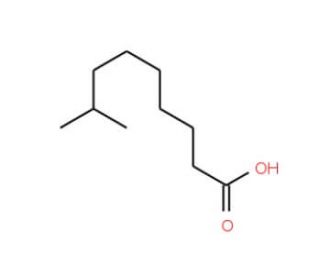

8-Methylnonanoic acid (CAS 5963-14-4)
QUICK LINKS
8-Methylnonanoic acid is a branched-chain fatty acid that has garnered attention in biochemical and analytical research due to its unique structural properties and biological functions. This compound is often used as a model to study the impact of methyl branching on fatty acid behavior and metabolism. Research has shown that the presence of a methyl group at the eighth carbon influences the fluidity and phase behavior of lipid bilayers, affecting membrane dynamics and protein interactions. Studies have explored how 8-methylnonanoic acid integrates into cellular membranes, altering their physical properties and potentially modulating the activity of membrane-bound enzymes and receptors. In metabolic studies, it serves as a substrate to investigate the specificity and activity of fatty acid synthase and desaturase enzymes, shedding light on the mechanisms of fatty acid biosynthesis and modification. Additionally, this compound is utilized in the field of analytical chemistry as a reference standard in gas chromatography and mass spectrometry for the identification and quantification of branched-chain fatty acids in complex biological samples. Its distinct structure aids in elucidating the metabolic pathways and regulatory mechanisms involving branched-chain fatty acids. Overall, 8-methylnonanoic acid is a valuable tool in advancing our understanding of lipid biochemistry and membrane biology.
8-Methylnonanoic acid (CAS 5963-14-4) References
- Total synthesis of the novel bacterial fatty acid 16-methyl-8(Z)-heptadecenoic acid. | Carballeira, NM. and Pagán, M. 2001. Chem Phys Lipids. 113: 23-7. PMID: 11687224
- Utilization of capsaicin and vanillylamine as growth substrates by Capsicum (hot pepper)-associated bacteria. | Flagan, SF. and Leadbetter, JR. 2006. Environ Microbiol. 8: 560-5. PMID: 16478462
- Influence of dietary inclusion of tannin extracts from mimosa, chestnut and tara on volatile compounds and flavour in lamb meat. | Del Bianco, S., et al. 2021. Meat Sci. 172: 108336. PMID: 33091724
- Pennelliiside D, a New Acyl Glucose from Solanum pennellii and Chemical Synthesis of Pennelliisides. | Masimbula, R., et al. 2022. Molecules. 27: PMID: 35744854
- Gluten-Free Bread Enriched with Artichoke Leaf Extract In Vitro Exerted Antioxidant and Anti-Inflammatory Properties. | Vacca, M., et al. 2023. Antioxidants (Basel). 12: PMID: 37107220
- Isolation of Fatty Acids from the Enzymatic Hydrolysis of Capsaicinoids and Their Use in Enzymatic Acidolysis of Coconut Oil. | Kanprakobkit, W., et al. 2023. J Oleo Sci. 72: 1097-1111. PMID: 37989304
- Optimization of ultrasound-aided extraction of bioactive ingredients from Vitis vinifera seeds using RSM and ANFIS modeling with machine learning algorithm. | Kunjiappan, S., et al. 2024. Sci Rep. 14: 1219. PMID: 38216594
- The Analysis of Leontopodium leontopodioides (Willd.) Beauv. Chemical Composition by GC/MS and UPLC-Q-Orbitrap MS. | Chen, Y., et al. 2024. Int J Anal Chem. 2024: 3525212. PMID: 38745727
- [Anodic synthesis of 8-methylnonanoic acid and 8-methylnon-trans-6-enoic acid. The synthesis of dihydrocapsaicin and capsaicin (author′s transl)]. | Takahashi, M., et al. 1976. Yakugaku Zasshi. 96: 137-9. PMID: 985857
Ordering Information
| Product Name | Catalog # | UNIT | Price | Qty | FAVORITES | |
8-Methylnonanoic acid, 250 mg | sc-280582 | 250 mg | $265.00 |