
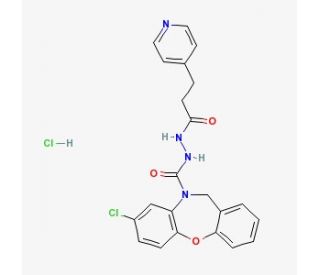

SC51089 (CAS 146033-02-5)
QUICK LINKS
sc-51089 is a selective antagonist of prostaglandin E2, which displays specificity towards the EP1 receptor subtype. Studies indicate that sc-51089 can induce nociceptive behaviors in rats as a result of its antagonistic effects on prostaglandin E2. This compound contains a diacylhydrazine moiety, which has often been observed to release hydrazine. Alternate studies suggest that sc-51089 can be metabolized by rat and human hepatocytes, however different metabolic products are produced. For instance, sc-51089 undergoes aromatic hydroxylation with consequent glucuronidation and sulphation in human hepatocytes, while oxidative N-dealkylation with opening of the oxazepine ring and consequent glucuronidation in observed in rat hepatocytes. sc-51089 is an inhibitor of EP2 and EP3.
SC51089 (CAS 146033-02-5) References
- Inhibition of human glioma cell growth by a PHS-2 inhibitor, NS398, and a prostaglandin E receptor subtype EP1-selective antagonist, SC51089. | Matsuo, M., et al. 2004. J Neurooncol. 66: 285-92. PMID: 15015658
- Neuroprotection by PGE2 receptor EP1 inhibition involves the PTEN/AKT pathway. | Zhou, P., et al. 2008. Neurobiol Dis. 29: 543-51. PMID: 18178094
- Prostaglandin E2 EP1 receptor inhibition fails to provide neuroprotection in surgically induced brain-injured mice. | Khatibi, NH., et al. 2011. Acta Neurochir Suppl. 111: 277-81. PMID: 21725768
- Blockage of progesterone receptor effectively protects pancreatic islet beta cell viability. | Zhou, R., et al. 2013. Steroids. 78: 987-95. PMID: 23827354
- Antagonism of the prostaglandin E2 EP1 receptor in MDCK cells increases growth through activation of Akt and the epidermal growth factor receptor. | Taub, M., et al. 2014. Am J Physiol Renal Physiol. 307: F539-50. PMID: 25007872
- Toxic role of prostaglandin E2 receptor EP1 after intracerebral hemorrhage in mice. | Zhao, X., et al. 2015. Brain Behav Immun. 46: 293-310. PMID: 25697396
- Role of spinal cyclooxygenase-2 and prostaglandin E2 in fentanyl-induced hyperalgesia in rats. | Li, QB., et al. 2018. Br J Anaesth. 120: 827-835. PMID: 29576123
- EP1 receptor is involved in prostaglandin E2-induced osteosarcoma growth. | Niu, JC., et al. 2019. Bosn J Basic Med Sci. 19: 265-273. PMID: 30995899
- Comparison of prostaglandin E1- and prostaglandin E2-induced hyperalgesia in the rat. | Khasar, SG., et al. 1994. Neuroscience. 62: 345-50. PMID: 7830882
- N-substituted dibenzoxazepines as analgesic PGE2 antagonists. | Hallinan, EA., et al. 1993. J Med Chem. 36: 3293-9. PMID: 7901416
- Antinociceptive effect of spinally delivered prostaglandin E receptor antagonists in the formalin test on the rat. | Malmberg, AB., et al. 1994. Neurosci Lett. 173: 193-6. PMID: 7936413
- Comparative metabolism of SC-42867 and SC-51089, two PGE2 antagonists, in rat and human hepatocyte cultures. | Lee, K., et al. 1994. Xenobiotica. 24: 25-36. PMID: 8165819
- Aminoacetyl moiety as a potential surrogate for diacylhydrazine group of SC-51089, a potent PGE2 antagonist, and its analogs. | Hallinan, EA., et al. 1996. J Med Chem. 39: 609-13. PMID: 8558534
Ordering Information
| Product Name | Catalog # | UNIT | Price | Qty | FAVORITES | |
SC51089, 5 mg | sc-201344 | 5 mg | $60.00 | |||
SC51089, 25 mg | sc-201344A | 25 mg | $316.00 |