
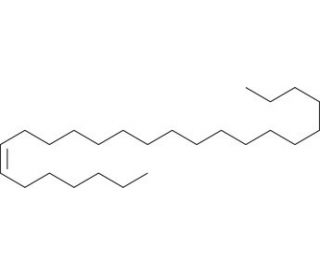

7(Z)-Pentacosene (CAS 63623-49-4)
QUICK LINKS
7(Z)-Pentacosene, with the CAS number 63623-49-4, is a naturally occurring long-chain alkene, specifically a hydrocarbon with 25 carbon atoms and a double bond in the cis configuration at the seventh position. This compound is of particular interest in ecological and evolutionary biology research rather than in medical domains. 7(Z)-Pentacosene has been extensively studied for its role as a pheromone in various insect species, including ants and termites. The double bond location in its alkene chain plays a crucial role in the molecule′s bioactivity, influencing how the compound interacts with pheromone receptors on insects. This specific configuration is thought to affect the shape and the electronic distribution of the molecule, which in turn affects its binding affinity to receptors and its subsequent biological activity. Researchers utilize 7(Z)-Pentacosene to study communication mechanisms within insect colonies, particularly how these chemicals mediate social behaviors such as colony aggregation, mate selection, and hierarchical structuring. Understanding these mechanisms can provide insights into the evolution of communication strategies in social insects. Moreover, studies involving 7(Z)-Pentacosene contribute to broader applications such as developing environmentally friendly pest control methods that exploit natural pheromonal communication pathways to manage insect populations.
7(Z)-Pentacosene (CAS 63623-49-4) References
- A stingless bee (Melipona seminigra) marks food sources with a pheromone from its claw retractor tendons. | Jarau, S., et al. 2004. J Chem Ecol. 30: 793-804. PMID: 15260224
- Developmental diet regulates Drosophila lifespan via lipid autotoxins. | Stefana, MI., et al. 2017. Nat Commun. 8: 1384. PMID: 29123106
- Drosophila HNF4 Directs a Switch in Lipid Metabolism that Supports the Transition to Adulthood. | Storelli, G., et al. 2019. Dev Cell. 48: 200-214.e6. PMID: 30554999
- Odor coding in the antenna of the tsetse fly Glossina morsitans. | Soni, N., et al. 2019. Proc Natl Acad Sci U S A. 116: 14300-14308. PMID: 31221757
- Molecular structure and electronic properties of oil shale kerogen: An experimental and molecular modeling study | Pan, S., Wang, Q., Bai, J., Chi, M., Cui, D., Wang, Z.,.. & Xu, F. 2018. Energy & fuels. 32(12): 12394-12404.
Ordering Information
| Product Name | Catalog # | UNIT | Price | Qty | FAVORITES | |
7(Z)-Pentacosene, 1 mg | sc-291655 | 1 mg | $42.00 | |||
7(Z)-Pentacosene, 5 mg | sc-291655A | 5 mg | $190.00 |