
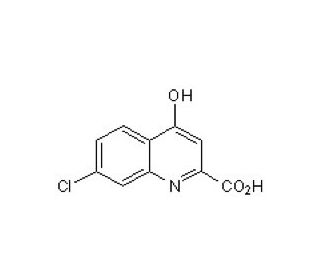

Molecular structure of 7-Chlorokynurenic acid, CAS Number: 18000-24-3
7-Chlorokynurenic acid (CAS 18000-24-3)
Alternate Names:
7-Chloro-4-hydroxyquinoline-2-carboxylic acid
Application:
7-Chlorokynurenic acid is an NMDA receptor antagonist and inhibitor of EAAT
CAS Number:
18000-24-3
Purity:
≥98%
Molecular Weight:
223.62
Molecular Formula:
C10H6CINO3
For Research Use Only. Not Intended for Diagnostic or Therapeutic Use.
* Refer to Certificate of Analysis for lot specific data.
QUICK LINKS
Ordering Information
Description
Technical Information
Safety Information
SDS & Certificate of Analysis
7-Chlorokynurenic acid is an NMDA receptor antagonist acting at the glycine site. 7-Chlorokynurenic acid acts as a potent competitive inhibitor of EAAT (L-glutamate transporter) into synaptic vesicles. 7-Chlorokynurenic acid is derived from kynurenic acid, a natural metabolite of tryptophan found in the mammalian brain. This compound has shown the ability to regulate NMDA receptor-mediated excitotoxicity.
7-Chlorokynurenic acid (CAS 18000-24-3) References
- New programs target outpatient utilization. | Kenkel, PJ. 1988. Mod Healthc. 18: 37. PMID: 10289013
- 7-Chlorokynurenic acid is a selective antagonist at the glycine modulatory site of the N-methyl-D-aspartate receptor complex. | Kemp, JA., et al. 1988. Proc Natl Acad Sci U S A. 85: 6547-50. PMID: 2842779
- The architecture of GluD2 ionotropic delta glutamate receptor elucidated by cryo-EM. | Burada, AP., et al. 2020. J Struct Biol. 211: 107546. PMID: 32512155
- Potential of kynurenine metabolites in drug development against neurodegenerative diseases. | Kubicova, L. and Chobot, V. 2021. Neural Regen Res. 16: 308-309. PMID: 32859788
- A randomized cross-over trial to define neurophysiological correlates of AV-101 N-methyl-D-aspartate receptor blockade in healthy veterans. | Murphy, N., et al. 2021. Neuropsychopharmacology. 46: 820-827. PMID: 33318635
- Targeting Transporters for Drug Delivery to the Brain: Can We Do Better? | Puris, E., et al. 2022. Pharm Res. 39: 1415-1455. PMID: 35359241
- AV-101, a Pro-Drug Antagonist at the NMDA Receptor Glycine Site, Reduces L-Dopa Induced Dyskinesias in MPTP Monkeys. | Bourque, M., et al. 2022. Cells. 11: PMID: 36428960
- Transporter-Mediated Drug Delivery. | Gyimesi, G. and Hediger, MA. 2023. Molecules. 28: PMID: 36770817
- The Effects of the Inhalant Toluene on Cognitive Function and Behavioral Flexibility: A Review of Recent Findings. | Woodward, JJ. and Braunscheidel, KM. 2023. Addict Neurosci. 5: PMID: 36798693
- Pharmacological Inhibition of Membrane Signaling Mechanisms Reduces the Invasiveness of U87-MG and U251-MG Glioblastoma Cells In Vitro. | Varricchio, A., et al. 2023. Cancers (Basel). 15: PMID: 36831372
- Nociceptor activity induces nonionotropic NMDA receptor signaling to enable spinal reconsolidation and reverse pathological pain. | Zhang, H., et al. 2023. Sci Adv. 9: eadg2819. PMID: 37205760
- Behavioral and neurochemical actions of the strychnine-insensitive glycine receptor antagonist, 7-chlorokynurenate, in rats. | Kretschmer, BD., et al. 1995. Eur J Pharmacol. 280: 37-45. PMID: 7498252
- Substituted quinolines as inhibitors of L-glutamate transport into synaptic vesicles. | Bartlett, RD., et al. 1998. Neuropharmacology. 37: 839-46. PMID: 9776380
Inhibitor of:
EAAT, and NMDA.Ordering Information
| Product Name | Catalog # | UNIT | Price | Qty | FAVORITES | |
7-Chlorokynurenic acid, 10 mg | sc-358717 | 10 mg | $81.00 | |||
7-Chlorokynurenic acid, 50 mg | sc-358717A | 50 mg | $342.00 |