
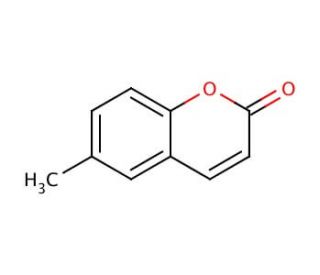

6-Methylcoumarin (CAS 92-48-8)
See product citations (1)
QUICK LINKS
6-Methylcoumarin (6-MC) emerges naturally within a range of plant species, standing as a derivative of coumarin and a prominent member of the coumarin compound family. The manifold biological activities exhibited by 6-Methylcoumarin have garnered substantial research attention, leading to its incorporation into diverse investigative endeavors. The practical employment of 6-Methylcoumarin spans various scientific research scenarios, spanning both in vivo and in vitro investigations. Within in vivo contexts, 6-Methylcoumarin has been employed to scrutinize its effects on the immune, cardiovascular, and neurological systems. In vitro studies, on the other hand, have delved into the influences of 6-Methylcoumarin on cellular growth, programmed cell death, and genetic expression. Though the precise operational framework of 6-Methylcoumarin remains partly veiled, its interaction with diverse cellular targets is hypothesized. Noteworthy among these are the enzyme cyclooxygenase-2 (COX-2), the transcription factor NF-κB, and the enzyme lipoxygenase. Alongside these interactions, 6-MC has demonstrated a capacity to hinder the synthesis of pro-inflammatory cytokines, including tumor necrosis factor-alpha (TNF-α), interleukin-1beta (IL-1β), and interleukin-6 (IL-6).
6-Methylcoumarin (CAS 92-48-8) References
- Simultaneous determination of 6-methylcoumarin and 7-methoxycoumarin in cosmetics using three-dimensional excitation-emission matrix fluorescence coupled with second-order calibration methods. | Nie, JF., et al. 2008. Talanta. 75: 1260-9. PMID: 18585211
- Biodistribution study of free and microencapsulated 6-methylcoumarin in Wistar rats by HPLC. | Hernández, AR., et al. 2015. Biomed Chromatogr. 29: 176-81. PMID: 24854221
- Inhibitory effects and oxidation of 6-methylcoumarin, 7-methylcoumarin and 7-formylcoumarin via human CYP2A6 and its mouse and pig orthologous enzymes. | Juvonen, RO., et al. 2016. Xenobiotica. 46: 14-24. PMID: 26068522
- Simultaneous Analysis of Simple Coumarins and Furocoumarines in Cigarettes by Solid-Phase Extraction with Gas Chromatography-Mass Spectrometry. | Zheng, Y., et al. 2017. J AOAC Int. 100: 1559-1564. PMID: 28425389
- A novel potent inhibitor of 2-amino-1-methyl-6-phenylimidazo[4,5-b] pyridine (PhIP) formation from Chinese chive: Identification, inhibitory effect and action mechanism. | Wang, Q., et al. 2021. Food Chem. 345: 128753. PMID: 33302112
- Discovery of a novel plant-derived agent against Ralstonia solanacearum by targeting the bacterial division protein FtsZ. | Yang, L., et al. 2021. Pestic Biochem Physiol. 177: 104892. PMID: 34301354
- Application of terahertz spectroscopy combined with density functional theory to analysis of intermolecular weak interactions for coumarin and 6-methylcoumarin. | Chen, T., et al. 2021. Spectrochim Acta A Mol Biomol Spectrosc. 263: 120159. PMID: 34325169
- Anti-Inflammatory Effects of 6-Methylcoumarin in LPS-Stimulated RAW 264.7 Macrophages via Regulation of MAPK and NF-κB Signaling Pathways. | Kang, JK., et al. 2021. Molecules. 26: PMID: 34500784
- 6-Methylcoumarin attenuates quorum sensing and biofilm formation in Pseudomonas aeruginosa PAO1 and its applications on solid surface coatings with polyurethane. | Bajire, SK., et al. 2021. Appl Microbiol Biotechnol. 105: 8647-8661. PMID: 34750645
- 6-Methylcoumarin rescues bacterial quorum sensing induced ribosome-inactivating stress in Caenorhabditis elegans. | Ramesh, P., et al. 2022. Microb Pathog. 173: 105833. PMID: 36265737
- Antifungal Activity of 6-Methylcoumarin against Valsa mali and Its Possible Mechanism of Action. | Chen, YZ., et al. 2022. J Fungi (Basel). 9: PMID: 36675826
- 6-Methylcoumarin Promotes Melanogenesis through the PKA/CREB, MAPK, AKT/PI3K, and GSK3β/β-Catenin Signaling Pathways. | Kim, T., et al. 2023. Molecules. 28: PMID: 37299026
- Mechanism for 6-methylcoumarin photoallergenicity. | Kato, S., et al. 1985. Toxicol Appl Pharmacol. 81: 295-301. PMID: 4060155
- Regulatory issues concerning AETT and 6-MC. | Eiermann, HJ. 1980. Contact Dermatitis. 6: 120-2. PMID: 7398262
- Comparison of the hepatic effects of coumarin, 3,4-dimethylcoumarin, dihydrocoumarin and 6-methylcoumarin in the rat. | Lake, BG., et al. 1994. Food Chem Toxicol. 32: 743-51. PMID: 8070739
Ordering Information
| Product Name | Catalog # | UNIT | Price | Qty | FAVORITES | |
6-Methylcoumarin, 5 g | sc-233626 | 5 g | $26.00 |