
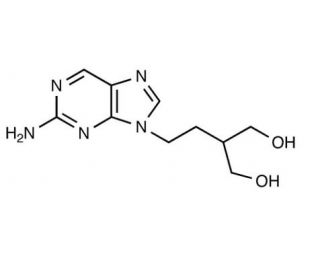

6-Deoxypenciclovir (CAS 104227-86-3)
QUICK LINKS
6-Deoxypenciclovir is a guanine nucleoside analog that is structurally related to penciclovir, with the key difference being the absence of a hydroxyl group at the 6′ position of the sugar moiety. This structural modification plays a crucial role in its interaction with cellular enzymes and its incorporation into nucleic acids. The primary mechanism of action of 6-Deoxypenciclovir involves its phosphorylation by cellular kinases. The monophosphate form is further phosphorylated by cellular guanylate kinase to the triphosphate form, which is the active form that competes with natural nucleotides for incorporation into DNA. Once incorporated into viral DNA by viral DNA polymerase, 6-Deoxypenciclovir triphosphate acts as a chain terminator. It lacks the necessary 3′-hydroxyl group required for forming the next phosphodiester bond in the DNA backbone, thereby halting the elongation of the DNA strand and inhibiting viral replication. In scientific research, 6-Deoxypenciclovir has been used extensively to study the specificity and mechanism of viral DNA polymerases, particularly for viruses such as herpes simplex virus (HSV) and varicella-zoster virus (VZV). By comparing the effects of 6-Deoxypenciclovir on viral versus cellular polymerases, researchers can gain insights into the structural and functional differences that underlie the selectivity of antiviral agents. Moreover, 6-Deoxypenciclovir is used in studies exploring the mechanisms of nucleoside analog resistance. Mutations in viral thymidine kinase or DNA polymerase can confer resistance to nucleoside analogs, and 6-Deoxypenciclovir helps in identifying and characterizing these mutations. This research is crucial for understanding how viruses evolve in response to antiviral agents and for designing the next generation of inhibitors.
6-Deoxypenciclovir (CAS 104227-86-3) References
- Aldehyde oxidase-catalysed oxidation of methotrexate in the liver of guinea-pig, rabbit and man. | Jordan, CG., et al. 1999. J Pharm Pharmacol. 51: 411-8. PMID: 10385213
- Synthesis and evaluation of 2-amino-9-(3-acyloxymethyl-4-alkoxycarbonyloxybut-1-yl)purines and 2-amino-9-(3-alkoxycarbonyloxymethyl-4-alkoxycarbonyloxybut-1- yl)purines as potential prodrugs of penciclovir. | Kim, DK., et al. 1999. Bioorg Med Chem. 7: 1715-25. PMID: 10482463
- Pharmacokinetic studies of 2-amino-9-(3-acetoxymethyl-4-isopropoxycarbonyl-oxybut-1-yl)purine, an oral prodrug for the antiviral agent penciclovir. | Choi, WS., et al. 2001. Drug Metab Dispos. 29: 945-9. PMID: 11408358
- In vitro-in vivo correlation for intrinsic clearance for drugs metabolized by human aldehyde oxidase. | Zientek, M., et al. 2010. Drug Metab Dispos. 38: 1322-7. PMID: 20444863
- A new multi-wavelength model-based method for determination of enzyme kinetic parameters. | Sorouraddin, MH., et al. 2010. J Biosci. 35: 395-403. PMID: 20826949
- Prediction of in vivo hepatic clearance and half-life of drug candidates in human using chimeric mice with humanized liver. | Sanoh, S., et al. 2012. Drug Metab Dispos. 40: 322-8. PMID: 22048522
- Mechanistic evaluation of substrate inhibition kinetics observed from aldehyde oxidase-catalyzed reactions. | Wang, SW., et al. 2013. Drug Metab Lett. 7: 2-14. PMID: 24151826
- Minipig and Human Metabolism of Aldehyde Oxidase Substrates: In Vitro-In Vivo Comparisons. | Wilkinson, DJ., et al. 2017. AAPS J. 19: 1163-1174. PMID: 28474310
- In vitro oxidation of famciclovir and 6-deoxypenciclovir by aldehyde oxidase from human, guinea pig, rabbit, and rat liver. | Rashidi, MR., et al. 1997. Drug Metab Dispos. 25: 805-13. PMID: 9224775
Ordering Information
| Product Name | Catalog # | UNIT | Price | Qty | FAVORITES | |
6-Deoxypenciclovir, 10 mg | sc-207111 | 10 mg | $380.00 |