
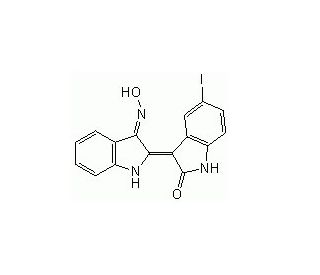

5-Iodo-Indirubin-3′-monoxime
ENLACES RÁPIDOS
La 5-yodo-indirrubina-3'-monoxime es un derivado sintético de la indirrubina. Esta sustancia química forma parte de la familia de las indirubinas, conocidas por su potente actividad inhibidora contra diversas quinasas, en particular las quinasas dependientes de ciclinas (CDK) y la glucógeno sintasa quinasa-3 (GSK-3). El mecanismo de acción de la 5-yodo-indirubina-3'-monoxime implica su interacción con los sitios de unión al ATP de estas quinasas. Al unirse a estos sitios, inhibe competitivamente la capacidad de las quinasas para fosforilar sus respectivos sustratos. Esta inhibición provoca la modulación de varios procesos celulares controlados por estas enzimas, como la progresión del ciclo celular y las vías de transducción de señales. La adición del átomo de yodo en la posición 5 de la molécula de indirubina aumenta su especificidad y potencia como inhibidor de cinasas. En investigación, la 5-yodo-indirrubina-3'-monoxime se ha utilizado ampliamente para estudiar la regulación del ciclo celular y la división celular, especialmente en líneas celulares de cáncer. Ha sido una herramienta valiosa para diseccionar los mecanismos moleculares que subyacen a las respuestas celulares a la inhibición de la cinasa, especialmente para comprender cómo pueden manipularse estas respuestas para controlar el crecimiento y la proliferación celulares.
5-Iodo-Indirubin-3′-monoxime Referencias
- La indirubina, componente activo de un medicamento chino contra la leucemia, inhibe las quinasas dependientes de ciclinas. | Hoessel, R., et al. 1999. Nat Cell Biol. 1: 60-7. PMID: 10559866
- Las indirubinas inhiben la glucógeno sintasa cinasa-3 beta y la CDK5/p25, dos proteínas cinasas implicadas en la fosforilación anormal de tau en la enfermedad de Alzheimer. ¿Una propiedad común a la mayoría de los inhibidores de las cinasas dependientes de ciclinas? | Leclerc, S., et al. 2001. J Biol Chem. 276: 251-60. PMID: 11013232
- El derivado de la indirrubina 7-bromoindirrubina-3-oxime (7Bio) atenúa los deterioros cognitivos inducidos por el oligómero Aβ en ratones | Liping Chen, et al. 2017. Frontiers in Molecular Neuroscience. 10: 393.
Información sobre pedidos
| Nombre del producto | Número de catálogo | UNIDAD | Precio | CANTIDAD | Favoritos | |
5-Iodo-Indirubin-3'-monoxime, 1 mg | sc-221754 | 1 mg | $108.00 |