
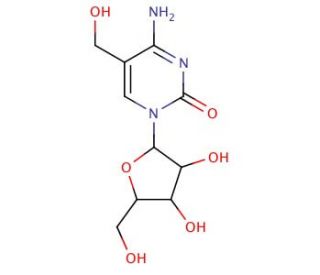

5-Hydroxymethylcytidine (CAS 19235-17-7)
QUICK LINKS
5-Hydroxymethylcytidine (5-HMC) is a modified version of the nucleoside cytidine, which occurs naturally in DNA and RNA. This unique compound holds significant importance as an epigenetic marker, garnering extensive scientific interest due to its involvement in gene expression, DNA methylation, and various cellular mechanisms. The synthesis of 5-Hydroxymethylcytidine takes place through the enzyme TET (Ten-eleven translocation), wherein it is generated from cytidine. Moreover, within cells, 5-Hydroxymethylcytidine is produced by the oxidation of 5-methylcytidine (5-mC). A pivotal player in biological processes, 5-Hydroxymethylcytidine partakes in a multitude of functions, including transcriptional regulation, chromatin remodeling, and DNA methylation. As an epigenetic regulator of gene expression, 5-Hydroxymethylcytidine binds to DNA and effectively modulates gene activity. Its involvement extends to chromatin remodeling, an essential process that orchestrates the packaging of DNA into chromatin structures. Furthermore, 5-Hydroxymethylcytidine plays a role in DNA methylation, which entails the addition of methyl groups to DNA. This process of DNA methylation is integral to epigenetic regulation, influencing gene expression and numerous cellular mechanisms.
5-Hydroxymethylcytidine (CAS 19235-17-7) References
- Synthesis of 5-Hydroxymethylcytidine- and 5-Hydroxymethyl-uridine-Modified RNA. | Riml, C. and Micura, R. 2016. Synthesis (Stuttg). 48: 1108-1116. PMID: 27413246
- Synthesis and Multiple Incorporations of 2'-O-Methyl-5-hydroxymethylcytidine, 5-Hydroxymethylcytidine and 5-Formylcytidine Monomers into RNA Oligonucleotides. | Tanpure, AA. and Balasubramanian, S. 2017. Chembiochem. 18: 2236-2241. PMID: 28901692
- A novel malic acid-enhanced method for the analysis of 5-methyl-2'-deoxycytidine, 5-hydroxymethyl-2'-deoxycytidine, 5-methylcytidine and 5-hydroxymethylcytidine in human urine using hydrophilic interaction liquid chromatography-tandem mass spectrometry. | Guo, C., et al. 2018. Anal Chim Acta. 1034: 110-118. PMID: 30193624
- Bisulfite-free and base-resolution analysis of 5-methylcytidine and 5-hydroxymethylcytidine in RNA with peroxotungstate. | Yuan, F., et al. 2019. Chem Commun (Camb). 55: 2328-2331. PMID: 30723849
- Radical Transfer Dissociation for De Novo Characterization of Modified Ribonucleic Acids by Mass Spectrometry. | Calderisi, G., et al. 2020. Angew Chem Int Ed Engl. 59: 4309-4313. PMID: 31867820
- Epitranscriptomic N4-Acetylcytidine Profiling in CD4+ T Cells of Systemic Lupus Erythematosus. | Guo, G., et al. 2020. Front Cell Dev Biol. 8: 842. PMID: 32984334
- Gut microbiota and fecal metabolites in captive and wild North China leopard (Panthera pardus japonensis) by comparsion using 16 s rRNA gene sequencing and LC/MS-based metabolomics. | Hua, Y., et al. 2020. BMC Vet Res. 16: 363. PMID: 32993639
- The Distinct Function and Localization of METTL3/METTL14 and METTL16 Enzymes in Cardiomyocytes. | Arcidiacono, OA., et al. 2020. Int J Mol Sci. 21: PMID: 33143367
- Development and validation of m6A regulators' prognostic significance for endometrial cancer. | Pang, X., et al. 2021. Medicine (Baltimore). 100: e26551. PMID: 34190193
- Base-resolution analysis of 5-hydroxymethylcytidine by selective oxidation and reverse transcription arrest. | Koyama, K., et al. 2021. Org Biomol Chem. 19: 6478-6486. PMID: 34241617
- Weakly supervised learning of RNA modifications from low-resolution epitranscriptome data. | Huang, D., et al. 2021. Bioinformatics. 37: i222-i230. PMID: 34252943
- A genome-phenome association study in native microbiomes identifies a mechanism for cytosine modification in DNA and RNA. | Yang, W., et al. 2021. Elife. 10: PMID: 34747693
- Significance of m6A regulatory factor in gene expression and immune function of osteoarthritis. | Xie, X., et al. 2022. Front Physiol. 13: 918270. PMID: 36160850
- Epitranscriptomics in myeloid malignancies. | Han, L., et al. 2022. Blood Sci. 4: 133-135. PMID: 36518589
- Cytidine deaminases catalyze the conversion of N(S,O)4-substituted pyrimidine nucleosides. | Urbelienė, N., et al. 2023. Sci Adv. 9: eade4361. PMID: 36735785
Ordering Information
| Product Name | Catalog # | UNIT | Price | Qty | FAVORITES | |
5-Hydroxymethylcytidine, 25 mg | sc-480669 | 25 mg | $469.00 | |||
5-Hydroxymethylcytidine, 250 mg | sc-480669A | 250 mg | $2501.00 |