
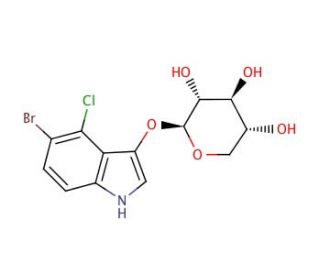

5-Bromo-4-chloro-3-indolyl β-D-xylopyranoside (CAS 207606-55-1)
ENLACES RÁPIDOS
El 5-bromo-4-cloro-3-indolil β-D-xilopiranósido es un sustrato cromogénico muy utilizado en bioquímica y biología molecular para la detección y el análisis de la actividad enzimática, concretamente de las xilosidasas. Este compuesto combina una fracción de indol halogenado con un grupo β-D-xilopiranósido, en el que el anillo de indol está modificado con sustituyentes de bromo y cloro, lo que aumenta su reactividad y especificidad frente a la escisión enzimática. Tras la hidrólisis por xilosidasas, este sustrato libera un indol halogenado, dando lugar a la formación de un producto coloreado o fluorescente que puede detectarse fácilmente mediante espectroscopia. Esta característica la hace especialmente útil para estudiar la cinética y el mecanismo de las xilosidasas, enzimas que desempeñan papeles cruciales en la degradación de carbohidratos complejos y son vitales para comprender el metabolismo de los carbohidratos en diversos sistemas biológicos. Además, se emplea en aplicaciones histoquímicas para localizar y cuantificar la actividad de las xilosidasas en muestras de tejido, lo que proporciona información valiosa sobre la distribución celular y la función de estas enzimas. El uso del 5-bromo-4-cloro-3-indolil β-D-xilopiranósido en investigación se centra por completo en aplicaciones científicas, en particular para mejorar nuestra comprensión de los procesos enzimáticos en contextos bioquímicos y celulares.
5-Bromo-4-chloro-3-indolyl β-D-xylopyranoside (CAS 207606-55-1) Referencias
- Expresión heteróloga y caracterización cinética de la β-xilosidasa de Neurospora crassa en Pichia pastoris. | Kirikyali, N. and Connerton, IF. 2014. Enzyme Microb Technol. 57: 63-8. PMID: 24629269
- La GH51 α-l-arabinofuranosidasa de Paenibacillus sp. THS1 es multifuncional, hidroliza enlaces glicosídicos de cadena principal y cadena lateral en heteroxilanos. | Bouraoui, H., et al. 2016. Biotechnol Biofuels. 9: 140. PMID: 27398094
- Halotolerant microbial consortia capable to degrade highly recalcitrant plant biomass substrate. | Cortes-Tolalpa, L., et al. 2018. Appl Microbiol Biotechnol. 102: 2913-2927. PMID: 29397428
- Cribado de β-xilosidasas multiméricas del microbioma intestinal de una termita superior, Globitermes brachycerastes. | Liu, C., et al. 2018. Int J Biol Sci. 14: 608-615. PMID: 29904275
- Modificación de regiones de ADN con fragmentos de ADN metagenómico (MDRMDF): Una estrategia conveniente para la ingeniería eficiente de proteínas. | Xu, S., et al. 2021. Biochimie. 187: 75-81. PMID: 34051307
- Inmovilización y propiedades bioquímicas de una β-xilosidasa activada por glucosa/xilosa de Aspergillus niger USP-67 con actividad de transxilosilación. | Benassi, Vivian Machado, et al. 2013. Journal of Molecular Catalysis B: Enzymatic. 89: 93-101.
- Consorcios muy tolerantes a la salinidad capaces de crecer en un sustrato muy recalcitrante. | Tolalpa, Larisa Cortés, et al. 2018. Lignocellulose-degrading microbial consortia. 102.6: 95.
Información sobre pedidos
| Nombre del producto | Número de catálogo | UNIDAD | Precio | CANTIDAD | Favoritos | |
5-Bromo-4-chloro-3-indolyl β-D-xylopyranoside, 25 mg | sc-256898 | 25 mg | $93.00 |