
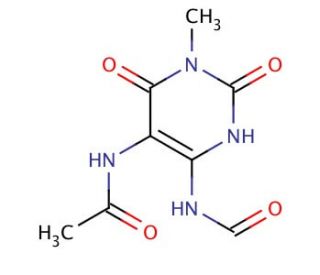

Struttura molecolare di 5-Acetylamino-6-formylamino-3-methyluracil, Numero CAS: 85438-96-6
5-Acetylamino-6-formylamino-3-methyluracil (CAS 85438-96-6)
Vedere citazioni di prodotto (2)
Nomi alternativi:
AFMU; 5-Acetylamino-6-formylamino-3-methyluracil
Applicazione:
5-Acetylamino-6-formylamino-3-methyluracil è un metabolita della caffeina
Numero CAS:
85438-96-6
Peso molecolare:
226.19
Formula molecolare:
C8H10N4O4
Solo per uso in Ricerca. Non previsto per Uso Diagnostico o Terapeutico.
* Vedere Certificato di Analisi per informazioni sul lotto specifico (incluso il contenuto d'acqua).
LINK RAPIDI
Informazioni ordini
Citazioni prodotti
Descrizione
Informazione tecnica
Informazioni di sicurezza
SDS & Certificato d'analisi
Si ritiene che il 5-acetilammino-6-formilammino-3-metiluracile funzioni inibendo l'enzima diidropirimidina deidrogenasi (DPD). La DPD è responsabile della scissione del nucleoside timidina. Inibendo la DPD, il 5-acetilammino-6-formilammino-3-metiluracile impedisce la scissione della timidina, determinando un aumento dei livelli di timidina nella cellula. Questo aumento dei livelli di timidina è ritenuto la causa degli effetti terapeutici del 5-acetilammino-6-formilammino-3-metiluracile.
5-Acetylamino-6-formylamino-3-methyluracil (CAS 85438-96-6) Referenze
- Validità di un ELISA per la fenotipizzazione della N-acetiltransferasi-2 (NAT2). | Wong, P., et al. 2001. J Immunol Methods. 251: 1-9. PMID: 11292476
- Stabilità del 5-acetamido-6-formilamino-3-metiluracile in tamponi e urine. | Wong, P., et al. 2002. J Pharm Biomed Anal. 28: 693-700. PMID: 12008149
- Fenotipizzazione della N-acetiltransferasi di tipo 2 da parte della caffeina da esposizione alimentare incontrollata. | Jetter, A., et al. 2004. Eur J Clin Pharmacol. 60: 17-21. PMID: 14747882
- Nuova indagine sulla concordanza dei fenotipi e dei genotipi NAT2 umani. | Bolt, HM., et al. 2005. Arch Toxicol. 79: 196-200. PMID: 15558239
- Misurazione della caffeina e di cinque dei principali metaboliti nelle urine mediante cromatografia liquida ad alte prestazioni/spettrometria di massa in tandem. | Weimann, A., et al. 2005. J Mass Spectrom. 40: 307-16. PMID: 15685651
- Valutazione in vivo delle attività di CYP1A2, CYP2A6, NAT-2 e xantina ossidasi in un campione di popolazione greca mediante il monitoraggio RP-HPLC dei rapporti metabolici della caffeina. | Begas, E., et al. 2007. Biomed Chromatogr. 21: 190-200. PMID: 17221922
- Rapporti metabolici della caffeina per la valutazione in vivo delle attività enzimatiche di CYP1A2, N-acetiltransferasi 2, xantina ossidasi e CYP2A6. | Hakooz, NM. 2009. Curr Drug Metab. 10: 329-38. PMID: 19519341
- Metaboloma sierico del consumo di caffè e sua associazione con la densità minerale ossea: Lo studio sull'osteoporosi di Hong Kong. | Chau, YP., et al. 2020. J Clin Endocrinol Metab. 105: PMID: 31750515
- Isolamento e identificazione del 5-acetilammino-6-formilammino-3-metiluracile come metabolita principale della caffeina nell'uomo. | Tang, BK., et al. 1983. Drug Metab Dispos. 11: 218-20. PMID: 6135579
- N-acetilazione polimorfa di un metabolita della caffeina. | Grant, DM., et al. 1983. Clin Pharmacol Ther. 33: 355-9. PMID: 6825389
- Fenotipi di acetilazione e variazione biologica in una popolazione caucasica francese. | Pontes, ZB., et al. 1993. Eur J Clin Chem Clin Biochem. 31: 59-68. PMID: 8467011
- Predominanza di acetilatori lenti di N-acetiltransferasi in una popolazione Hmong residente negli Stati Uniti. | Straka, RJ., et al. 1996. J Clin Pharmacol. 36: 740-7. PMID: 8877679
- Genotipo e fenotipo del polimorfismo della N-acetiltransferasi 2 (NAT2) in pazienti con allergia da contatto. | Schnuch, A., et al. 1998. Contact Dermatitis. 38: 209-11. PMID: 9565293
Informazioni ordini
| Nome del prodotto | Codice del prodotto | UNITÀ | Prezzo | Quantità | Preferiti | |
5-Acetylamino-6-formylamino-3-methyluracil, 5 mg | sc-210263 | 5 mg | $383.00 |