
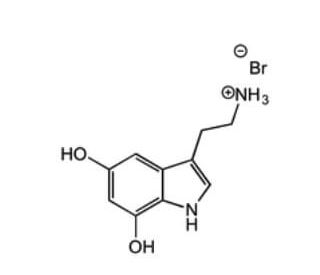

5,7-Dihydroxytryptamine hydrobromide (CAS 1841081-30-8)
See product citations (1)
QUICK LINKS
5,7-Dihydroxytryptamine hydrobromide is a compound used in neurochemical research to investigate the function of serotonergic systems. It acts as a neurotoxin that selectively targets serotonin transporters, leading to the disruption of serotonin pathways. By understanding the effects of 5,7-Dihydroxytryptamine hydrobromide on these pathways, researchers can gain insights into the complex roles of serotonin in neurotransmission and the mechanisms that underlie neurotoxicity. The compound′s utility extends to the study of neuronal recovery and plasticity after disruption of serotonergic transmission. As a research tool, 5,7-Dihydroxytryptamine hydrobromide is also valuable in the exploration of molecular and cellular responses to altered serotonin levels within neural tissue.
5,7-Dihydroxytryptamine hydrobromide (CAS 1841081-30-8) References
- Possible involvement of descending serotonergic systems in antinociception by centrally administered elcatonin in mice. | Nakamoto, H., et al. 1999. Biol Pharm Bull. 22: 691-7. PMID: 10443464
- Intrastriatal injection of 5,7-dihydroxytryptamine decreased 5-HT levels in the striatum and suppressed locomotor activity in C57BL/6 mice. | Chia, LG., et al. 1999. Neurochem Res. 24: 719-22. PMID: 10447454
- 5,7-Dihydroxytryptamine--a selective marker of dopaminergic or serotonergic neurons? | Franke, H., et al. 2002. Naunyn Schmiedebergs Arch Pharmacol. 366: 315-8. PMID: 12237744
- 5,7-dihydroxytryptamine lesion of the dorsal raphe nucleus alters neuronal activity of the subthalamic nucleus in normal and 6-hydroxydopamine-lesioned rats. | Liu, J., et al. 2007. Brain Res. 1149: 216-22. PMID: 17376410
- Attenuation of the effects of d-amphetamine on interval timing behavior by central 5-hydroxytryptamine depletion. | Body, S., et al. 2009. Psychopharmacology (Berl). 203: 547-59. PMID: 19018519
- 5,7-dihydroxytryptamine injections into the prefrontal cortex and nucleus accumbens differently affect prepulse inhibition and baseline startle magnitude in rats. | Mohr, D., et al. 2009. Behav Brain Res. 202: 58-63. PMID: 19447281
- Sex-related differences in descending norepinephrine and serotonin controls of spinal withdrawal reflex during intramuscular saline induced muscle nociception in rats. | Lei, J., et al. 2011. Exp Neurol. 228: 206-14. PMID: 21238453
- Does 5, 7-Dihydroxytryptamine injection into nucleus accumbens cause hyperacusis? | Farahani, S., et al. 2019. Neurosci Lett. 705: 246-250. PMID: 30970270
- Elimination of Serotonergic Neurons by Stereotaxic Injection of 5,7-Dihydroxytryptamine in the Dorsal Raphe Nuclei of Mice. | Cao, L., et al. 2020. J Vis Exp.. PMID: 32420992
- The guinea pig myoclonic model: behavioral supersensitivity to 5-hydroxytryptophan induced by intracisternal 5,7-dihydroxytryptamine. | Pranzatelli, MR. and Snodgrass, SR. 1987. Eur J Pharmacol. 143: 237-42. PMID: 3500866
- Effect of 5,7-dihydroxytryptamine on the development of tolerance to ethanol. | Lê, AD., et al. 1980. Psychopharmacology (Berl). 67: 143-6. PMID: 6768090
- Effect of 5,7-dihydroxytryptamine on serotonergic control of prolactin secretion and behavior in rats. | Kuhn, CM., et al. 1981. Psychopharmacology (Berl). 73: 188-93. PMID: 6785814
- Induction of hypothermia as a model of 5-hydroxytryptamine1A receptor-mediated activity in the rat: a pharmacological characterization of the actions of novel agonists and antagonists. | Millan, MJ., et al. 1993. J Pharmacol Exp Ther. 264: 1364-76. PMID: 8450471
- 5,7-Dihydroxytryptamine uptake discriminates living serotonergic cells from dopaminergic cells in rat midbrain culture. | Rohrbacher, J., et al. 1995. Neurosci Lett. 199: 207-10. PMID: 8577399
- Developmental alterations in 5-hydroxytryptamine concentration and turnover after treatment of neonatal rats with 5,7-dihydroxytryptamine. | Mercugliano, M., et al. 1996. Neurobiol Learn Mem. 65: 163-76. PMID: 8833105
Ordering Information
| Product Name | Catalog # | UNIT | Price | Qty | FAVORITES | |
5,7-Dihydroxytryptamine hydrobromide, 10 mg | sc-505629 | 10 mg | $233.00 | |||
5,7-Dihydroxytryptamine hydrobromide, 25 mg | sc-505629A | 25 mg | $461.00 | |||
5,7-Dihydroxytryptamine hydrobromide, 50 mg | sc-505629B | 50 mg | $675.00 | |||
5,7-Dihydroxytryptamine hydrobromide, 100 mg | sc-505629C | 100 mg | $1250.00 |