
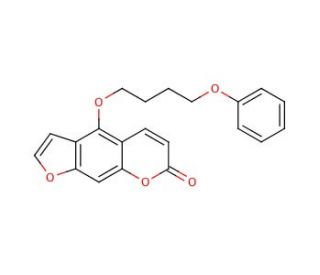

5-(4-Phenoxybutoxy)psoralen (CAS 870653-45-5)
See product citations (1)
QUICK LINKS
5-(4-Phenoxybutoxy)psoralen also referred to as AS-77 and PAP-1, is a blocker of the KCNA3 channel, specifically targeting the Kv1.3 channels. This compound shows potential for treating plaque psoriasis by interfering with the activation and proliferation of effector memory T cells, which are in the development of autoimmune diseases. Notably, PAP-1 reduces the secretion of TNFα by adipose tissue but does not affect the secretion of IL-6. Additionally, PAP-1 demonstrates the ability to inhibit the exocytosis of cytoplasmic granules from CD4(+)CD28(null) T cells. Its inhibitory effects are specific to Kv1.3 voltage-gated potassium channels, with an EC50 value of 2 nM at -80 mV in cells expressing the human channel. PAP-1 exhibits selectivity for Kv1.3 over a range of 22 ion channels, including potassium, sodium, calcium, and chloride channels, with EC50 values ranging from 45 to 15,000 nM. In experiments, PAP-1 inhibits the proliferation of isolated human CCR7- effector memory T cells induced by anti-CD3 antibodies. In vivo studies using rats have shown that PAP-1, at a dose of 3 mg/kg, can inhibit ovalbumin-induced delayed-type hypersensitivity.
5-(4-Phenoxybutoxy)psoralen (CAS 870653-45-5) References
- Design of PAP-1, a selective small molecule Kv1.3 blocker, for the suppression of effector memory T cells in autoimmune diseases. | Schmitz, A., et al. 2005. Mol Pharmacol. 68: 1254-70. PMID: 16099841
- Pharmacokinetics, toxicity, and functional studies of the selective Kv1.3 channel blocker 5-(4-phenoxybutoxy)psoralen in rhesus macaques. | Pereira, LE., et al. 2007. Exp Biol Med (Maywood). 232: 1338-54. PMID: 17959847
- 4-Phenoxybutoxy-substituted heterocycles--a structure-activity relationship study of blockers of the lymphocyte potassium channel Kv1.3. | Bodendiek, SB., et al. 2009. Eur J Med Chem. 44: 1838-52. PMID: 19056148
- Potassium channel block by a tripartite complex of two cationophilic ligands and a potassium ion. | Zimin, PI., et al. 2010. Mol Pharmacol. 78: 588-99. PMID: 20601455
- Identification of phase-I metabolites and chronic toxicity study of the Kv1.3 blocker PAP-1 (5-(4-phenoxybutoxy)psoralen) in the rat. | Hao, B., et al. 2011. Xenobiotica. 41: 198-211. PMID: 21070145
- HIV-1 Tat protein increases microglial outward K(+) current and resultant neurotoxic activity. | Liu, J., et al. 2013. PLoS One. 8: e64904. PMID: 23738010
- Stimulation of glucose uptake in murine soleus muscle and adipocytes by 5-(4-phenoxybutoxy)psoralen (PAP-1) may be mediated by Kv1.5 rather than Kv1.3. | Ngala, RA., et al. 2014. PeerJ. 2: e614. PMID: 25320682
- In silico identification of PAP-1 binding sites in the Kv1.2 potassium channel. | Jorgensen, C., et al. 2015. Mol Pharm. 12: 1299-307. PMID: 25734225
- Methamphetamine potentiates HIV-1gp120-induced microglial neurotoxic activity by enhancing microglial outward K+ current. | Liu, J., et al. 2017. Mol Cell Neurosci. 82: 167-175. PMID: 28552341
- Inhibition of Voltage-Gated K+ Channel Kv1.5 by Antiarrhythmic Drugs. | Chen, R. and Chung, SH. 2018. Biochemistry. 57: 2704-2710. PMID: 29652491
- An Angiopep2-PAPTP Construct Overcomes the Blood-Brain Barrier. New Perspectives against Brain Tumors. | Parrasia, S., et al. 2021. Pharmaceuticals (Basel). 14: PMID: 33562146
- The voltage-gated potassium channel KV1.3 regulates neutrophil recruitment during inflammation. | Immler, R., et al. 2022. Cardiovasc Res. 118: 1289-1302. PMID: 33881519
- Blockade of Kv1.3 Potassium Channel Inhibits Microglia-Mediated Neuroinflammation in Epilepsy. | Zhang, X., et al. 2022. Int J Mol Sci. 23: PMID: 36499018
Ordering Information
| Product Name | Catalog # | UNIT | Price | Qty | FAVORITES | |
5-(4-Phenoxybutoxy)psoralen, 5 mg | sc-252247 | 5 mg | $118.00 | |||
5-(4-Phenoxybutoxy)psoralen, 25 mg | sc-252247A | 25 mg | $728.00 |