
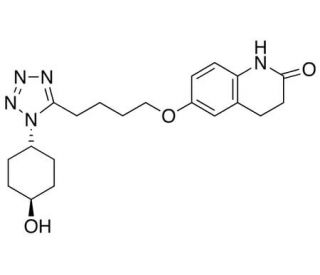

4′-trans-Hydroxy Cilostazol (CAS 87153-04-6)
Ver las publicaciones del producto (1)
ENLACES RÁPIDOS
El 4'-trans-hidroxi cilostazol (4'-HC) es un compuesto antiagregante plaquetario sintético no esteroideo. Se ha evaluado su capacidad para reducir la agregación plaquetaria, disminuyendo así el riesgo de trombosis. Además, los estudios han investigado sus posibles efectos antiinflamatorios y su capacidad para mitigar el riesgo de cáncer. El mecanismo de acción del 4'-trans-hidroxi cilostazol consiste en inhibir la enzima fosfodiesterasa III (PDEIII), responsable de la degradación del AMPc y el GMPc, reguladores esenciales de la agregación plaquetaria. Al inhibir esta enzima, el 4'-trans-hidroxi cilostazol impide la degradación del AMPc y el GMPc, lo que conduce a una disminución de la agregación plaquetaria. Además, el 4'-trans-hidroxi cilostazol presenta propiedades antiinflamatorias al suprimir la producción de citoquinas proinflamatorias in vitro.
4′-trans-Hydroxy Cilostazol (CAS 87153-04-6) Referencias
- Determinación cuantitativa de cilostazol y sus cuatro metabolitos en mezclas de incubación de microsomas hepáticos humanos mediante cromatografía líquida de alta resolución. | Tata, PN., et al. 1998. J Pharm Biomed Anal. 18: 441-51. PMID: 10096838
- Determinación cuantitativa simultánea de cilostazol y sus metabolitos en plasma humano mediante cromatografía líquida de alta resolución. | Fu, CJ., et al. 1999. J Chromatogr B Biomed Sci Appl. 728: 251-62. PMID: 10406210
- Método para el análisis cuantitativo de cilostazol y sus metabolitos en plasma humano mediante LC/MS/MS. | Bramer, SL., et al. 2001. J Pharm Biomed Anal. 26: 637-50. PMID: 11516916
- Inhibición de la apoptosis inducida por lipopolisacáridos mediante cilostazol en células endoteliales de vena umbilical humana. | Kim, KY., et al. 2002. J Pharmacol Exp Ther. 300: 709-15. PMID: 11805237
- Cilostazol para superar la alta reactividad plaquetaria al tratamiento en pacientes coreanos tratados con clopidogrel y antagonistas del calcio. | Jeong, YH., et al. 2011. Circ J. 75: 2534-6. PMID: 21970840
- K-134, un inhibidor de la fosfodiesterasa 3, previene el daño cerebral inhibiendo la formación de trombos en un modelo de infarto cerebral de rata. | Yoshida, H., et al. 2012. PLoS One. 7: e46432. PMID: 23110051
- La aspirina y el probenecid inhiben la captación renal de cilostazol mediada por el transportador 3 de aniones orgánicos y el probenecid induce el metabolismo del cilostazol en la rata. | Wang, C., et al. 2014. Drug Metab Dispos. 42: 996-1007. PMID: 24692216
- Efectos del cilostazol en la farmacocinética del carvedilol tras su administración oral e intravenosa en ratas. | Lim, TH., et al. 2015. J Physiol Pharmacol. 66: 591-7. PMID: 26348083
- Captación hepática mediada por el polipéptido transportador de aniones orgánicos y el transportador de eflujo y excreción biliar de cilostazol y sus metabolitos en ratas y humanos. | Wang, C., et al. 2017. J Pharm Sci. 106: 2515-2523. PMID: 28535976
- Análisis de modelos farmacocinéticos de cilostazol y sus metabolitos activos (OPC-13015 y OPC-13213) tras múltiples dosis orales de cilostazol en voluntarios coreanos sanos. | Cui, A., et al. 2020. Xenobiotica. 50: 288-296. PMID: 31181990
- Conversión de cilostazol a OPC-13015 vinculada a la mitigación del deterioro cognitivo. | Saito, S., et al. 2021. Alzheimers Dement (N Y). 7: e12182. PMID: 34095441
- Impacto de la Farmacocinética del Cilostazol en el Desarrollo de Efectos Secundarios Cardiovasculares en Pacientes con Infarto Cerebral. | Yokoyama, T., et al. 2021. Biol Pharm Bull. 44: 1767-1774. PMID: 34719653
- El tratamiento posterior al ictus con K-134, un inhibidor de la fosfodiesterasa 3, mejora los resultados del ictus en el modelo de rata espontáneamente hipertensa propensa al ictus: evaluación comparativa de fármacos antiplaquetarios. | Yoshida, H., et al. 2022. J Pharmacol Sci. 148: 229-237. PMID: 35063138
- Metabolismo de un nuevo agente antitrombótico y vasodilatador, el cilostazol, en la rata, el perro y el hombre. | Akiyama, H., et al. 1985. Arzneimittelforschung. 35: 1133-40. PMID: 4074424
Información sobre pedidos
| Nombre del producto | Número de catálogo | UNIDAD | Precio | CANTIDAD | Favoritos | |
4′-trans-Hydroxy Cilostazol, 5 mg | sc-210206 | 5 mg | $401.00 |