
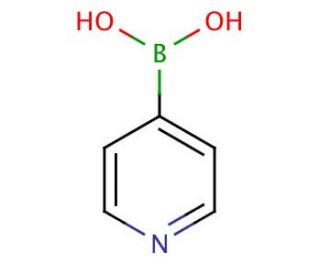

4-Pyridineboronic Acid (CAS 1692-15-5)
QUICK LINKS
4-Pyridineboronic Acid, represents a boronic acid derivative derived from pyridine. It holds significant importance as a chemical reagent in organic synthesis and finds wide-ranging applications within scientific research. Being a boronic acid, it exhibits the ability to react with aldehydes and ketones, resulting in the formation of boronate esters. These esters play a pivotal role in various reactions, including Suzuki-Miyaura cross-coupling, Stille coupling, and other transition metal-catalyzed reactions. Furthermore, it plays a significant role in the synthesis of polymers, and other organic compounds. Operating as a boronic acid, 4-Pyridineboronic Acid engages in reactions with aldehydes and ketones, leading to the formation of boronate esters.
4-Pyridineboronic Acid (CAS 1692-15-5) References
- Synthesis of a clathrochelate complex with an appended pyridine and its coordination to a cobaloxime complex. | Engtrakul, C., et al. 2000. Inorg Chem. 39: 5161-3. PMID: 11233217
- Diboronic acids as fluorescent probes for cells expressing sialyl Lewis X. | Yang, W., et al. 2002. Bioorg Med Chem Lett. 12: 2175-7. PMID: 12127531
- Boronic acid compounds as potential pharmaceutical agents. | Yang, W., et al. 2003. Med Res Rev. 23: 346-68. PMID: 12647314
- N-alkyl-4-boronopyridinium salts as thermally stable and reusable amide condensation catalysts. | Maki, T., et al. 2005. Org Lett. 7: 5043-6. PMID: 16235953
- A highly active catalyst for Suzuki-Miyaura cross-coupling reactions of heteroaryl compounds. | Billingsley, KL., et al. 2006. Angew Chem Int Ed Engl. 45: 3484-8. PMID: 16639772
- Synthesis and preliminary DNA-binding studies of diimineplatinum(II) complexes containing 3- or 4-pyridineboronic acid. | Ching, HY., et al. 2007. Dalton Trans. 2121-6. PMID: 17514332
- An experimental and theoretical study of molecular structure and vibrational spectra of 3- and 4-pyridineboronic acid molecules by density functional theory calculations. | Kurt, M., et al. 2008. Spectrochim Acta A Mol Biomol Spectrosc. 70: 664-73. PMID: 17933583
- Enhanced pi conjugation around a porphyrin[6] nanoring. | Hoffmann, M., et al. 2008. Angew Chem Int Ed Engl. 47: 4993-6. PMID: 18506860
- Synthesis, carbohydrate- and DNA-binding studies of cationic 2,2':6',2''-terpyridineplatinum(II) complexes containing N- and S-donor boronic acid ligands. | Hosseini, SS., et al. 2011. Dalton Trans. 40: 506-13. PMID: 21088793
- SAR studies of 4-pyridyl heterocyclic anilines that selectively induce autophagic cell death in von Hippel-Lindau-deficient renal cell carcinoma cells. | Bonnet, M., et al. 2011. Bioorg Med Chem. 19: 3347-56. PMID: 21561782
- N-containing boronic esters as self-complementary building blocks for the assembly of 2D and 3D molecular networks. | Cruz-Huerta, J., et al. 2012. Chem Commun (Camb). 48: 4241-3. PMID: 22436966
- Octadecanuclear gear wheels by self-assembly of self-assembled 'double saddle'-type coordination entities: molecular 'rangoli'. | Dasary, H., et al. 2015. Chemistry. 21: 1499-507. PMID: 25413031
- Synthesis and Utility of Dihydropyridine Boronic Esters. | Panda, S., et al. 2016. Angew Chem Int Ed Engl. 55: 2205-9. PMID: 26694785
- Fragment-based drug discovery of potent and selective MKK3/6 inhibitors. | Adams, M., et al. 2016. Bioorg Med Chem Lett. 26: 1086-1089. PMID: 26704264
- Construction of Heterobiaryl Skeletons through Pd-Catalyzed Cross-Coupling of Nitroarenes and Heterocyclic Arylborononate Esters with a Sterically Demanding NHC Ligand. | Chen, W., et al. 2022. Org Lett. 24: 6983-6987. PMID: 36135327
Ordering Information
| Product Name | Catalog # | UNIT | Price | Qty | FAVORITES | |
4-Pyridineboronic Acid, 5 g | sc-217007 | 5 g | $38.00 |