
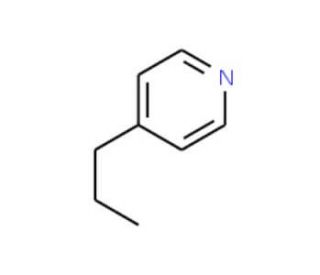

4-Propylpyridine (CAS 1122-81-2)
QUICK LINKS
4-Propylpyridine is a compound that finds use in various research disciplines, where its properties as a ligand are often explored. In coordination chemistry, it is used to study the binding behavior of nitrogen-containing heterocycles with transition metals, which is fundamental to understanding the nature of metal-ligand interactions. This compound is also involved in the design and synthesis of metal-organic frameworks (MOFs), where it can contribute to the framework′s stability and porosity. In addition, 4-Propylpyridine′s ability to act as a base makes it relevant in acid-base chemistry studies, where it is used to probe the strength and reactivity of acids. The compound′s role in the self-assembly of supramolecular structures is another area of research interest, as it can participate in hydrogen bonding and pi-pi interactions, which are key to the formation of complex molecular architectures. Furthermore, 4-Propylpyridine serves as a model compound in the study of organic reactions involving pyridine derivatives, which helps in the development of synthetic strategies for nitrogen-containing compounds.
4-Propylpyridine (CAS 1122-81-2) References
- An efficient recognition motif for an alkyl moiety in water. | Mizutani, T., et al. 2003. Chem Commun (Camb). 2918-9. PMID: 14680240
- Thermodynamics of hydrophobic interactions: entropic recognition of a hydrophobic moiety by poly(ethylene oxide)-zinc porphyrin conjugates. | Iwamoto, H., et al. 2007. Chem Asian J. 2: 1267-75. PMID: 17691075
- 4-isopropylpyridine hydroperoxide crystals resulting from the aerobic oxidation of a 4-isopropylpyridine/4-propylpyridine mixture. | Vaganova, E., et al. 2009. J Phys Chem B. 113: 4555-9. PMID: 19275133
- 4-n-Propyl-picolinic and -pipe-colinic acids; limitations of the Wibaut-Arens reaction with alpha-substituted pyridine derivatives. | SOLOMON, W. 1946. J Chem Soc. 934-6. PMID: 20282470
- Chloroacetate-promoted selective oxidation of heterobenzylic methylenes under copper catalysis. | Liu, J., et al. 2015. Angew Chem Int Ed Engl. 54: 1261-5. PMID: 25483218
- New ionic liquids based on the complexation of dipropyl sulfide and AlCl3 for electrodeposition of aluminum. | Fang, Y., et al. 2015. Chem Commun (Camb). 51: 13286-9. PMID: 26201079
- Allylmagnesium Bromide as a Selective Nucleophile toward Aza-aromatic Heterocycles | Henry Gilman, John Eisch, and Theodore Soddy. 1957,. J. Am. Chem. Soc. 79, 5,: 1245–1249.
- Anionopentaaminecobalt(III) complexes with polyamine ligands. XIV. The kinetics of aquation, mercury(II), assisted aquation and base hydrolysis of some chloro(diethylenetriamine)bis(monoamine)cobalt(III) complexes | Foo Chuk Ha, Donald A. House. 1980,. Inorganica Chimica Acta. Volume 38,: Pages 167-176.
- Coordination of Deprotonated Saccharin in Copper(II) Complexes. Structural Role of the Saccharinate Directed by the Ancillary N-heterocyclic Ligands | Panče Naumov, Gligor Jovanovski, Mirjana Ristova, Ibrahim Abdul Razak, Semiha Çkir, Suchada Chantrapromma, Hoong-Kun Fun, Seik Weng Ng. December 2002. Zeitschrift für anorganische und allgemeine Chemie. Volume628, Issue13: Pages 2930-2939.
- Synthesis and Aromatization of Hantzsch 1,4-Dihydropyridines under Microwave Irradiation. An Overview | by Jean Jacques Vanden Eynde 1,2,* andAnnie Mayence 1. 2003,. Molecules. 8(4),: 381-391.
- Electrochemically active species in aluminum electrodeposition baths of AlCl3/glyme solutions | . 1 September 2016,. Electrochimica Acta. Volume 211,: Pages 561-567.
- Electrodeposition of aluminum from AlCl3/acetamide eutectic solvent | Min Li a b, Bingliang Gao a b, Chengyuan Liu a b, Wenting Chen a b, Zhongning Shi a b, Xianwei Hu a b, Zhaowen Wang a b. 20 October 2015,. Electrochimica Acta. Volume 180,: Pages 811-814.
- Dicationic pyridinium salts as new organic ionics: Changes in solid-state phases and thermal/electrochemical properties | Jong Chan Shin a, Seok-In Lim b, Kwang-Un Jeong b, Joong Pyo Shim c, Minjae Lee a. 25 March 2022,. Journal of Industrial and Engineering Chemistry. Volume 107,: Pages 418-427.
Ordering Information
| Product Name | Catalog # | UNIT | Price | Qty | FAVORITES | |
4-Propylpyridine, 1 g | sc-262150 | 1 g | $34.00 | |||
4-Propylpyridine, 5 g | sc-262150A | 5 g | $135.00 |