
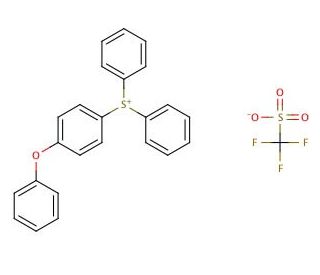

(4-Phenoxyphenyl)diphenylsulfonium triflate (CAS 240482-96-6)
QUICK LINKS
(4-Phenoxyphenyl)diphenylsulfonium triflate is primarily investigated in the field of photopolymerization and photoresist technology due to its role as a photoacid generator. Research on this compound focuses on its ability to release strong acids upon exposure to ultraviolet light, which is critical in the development of fine patterns in semiconductor manufacturing. Studies explore the efficiency of (4-Phenoxyphenyl)diphenylsulfonium triflate in initiating acid-catalyzed polymerization reactions, which are essential for creating high-resolution photoresists. The stability and sensitivity of (4-Phenoxyphenyl)diphenylsulfonium triflate under different wavelengths and intensities of light are also rigorously tested to optimize its performance in various industrial applications. Additionally, the environmental impact of using (4-Phenoxyphenyl)diphenylsulfonium triflate, including its breakdown products and toxicity, is assessed to ensure safe and sustainable use in the electronics industry.
(4-Phenoxyphenyl)diphenylsulfonium triflate (CAS 240482-96-6) References
- Aerosol route to functional nanostructured inorganic and hybrid porous materials. | Boissiere, C., et al. 2011. Adv Mater. 23: 599-623. PMID: 20963791
- Remotely controllable liquid marbles. | Zhang, L., et al. 2012. Adv Mater. 24: 4756-60. PMID: 22833237
- Remote-controlled drug release from graphene oxide-capped mesoporous silica to cancer cells by photoinduced pH-jump activation. | He, D., et al. 2014. Langmuir. 30: 7182-9. PMID: 24924411
- A Wearable Colorimetric Dosimeter to Monitor Sunlight Exposure. | Wang, J., et al. 2018. Adv Mater Technol. 3: PMID: 33928184
- Materials with Tunable Optical Properties for Wearable Epidermal Sensing in Health Monitoring. | Han, F., et al. 2022. Adv Mater. 34: e2109055. PMID: 35258117
- Chromism-Integrated Sensors and Devices for Visual Indicators. | Seok, H., et al. 2022. Sensors (Basel). 22: PMID: 35684910
- Materials and device designs for an epidermal UV colorimetric dosimeter with near field communication capabilities | Araki, H., Kim, J., Zhang, S., Banks, A., Crawford, K. E., Sheng, X.,.. & Rogers, J. A. 2017. Advanced Functional Materials. 27(2): 1604465.
- Visualized UV photodetectors based on prussian blue/TiO2 for smart irradiation monitoring application | Qiu, M., Sun, P., Liu, Y., Huang, Q., Zhao, C., Li, Z., & Mai, W. 2018. Advanced Materials Technologies. 3(2): 1700288.
- Leather‐Based Multi‐Stimuli Responsive Chromisms | Jia, L., Zeng, S., Ding, H., Smith, A. T., LaChance, A. M., Farooqui, M. M.,.. & Sun, L. 2021. Advanced Functional Materials. 31(35): 2104427.
- Sunlight-Responsive Titania–Hydrated Tungsten Oxide Heteronanoparticles/Paper-Based Color-Switching Film for Solar Ultraviolet Radiation Monitors | Zhao, J., Zhang, Y., Liu, F., Yan, M., Wang, X., & Wang, W. 2022. ACS Applied Nano Materials. 5(3): 4009-4017.
Ordering Information
| Product Name | Catalog # | UNIT | Price | Qty | FAVORITES | |
(4-Phenoxyphenyl)diphenylsulfonium triflate, 1 g | sc-396963 | 1 g | $102.00 |