
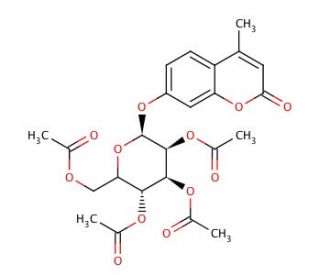

4-Methylumbelliferyl 2,3,4,6-Tetra-O-acetyl-β-D-glucopyranoside (CAS 67909-25-5)
QUICK LINKS
4-Methylumbelliferyl 2,3,4,6-Tetra-O-acetyl-β-D-glucopyranoside has emerged as a valuable substrate in enzymatic assays and research related to carbohydrate metabolism and enzyme kinetics. As a fluorogenic substrate, it is widely used for the detection and quantification of β-glucosidase activity in various biological samples. Upon hydrolysis by β-glucosidase, the acetyl groups are cleaved, resulting in the release of 4-methylumbelliferone (4-MU), a highly fluorescent compound. This enzymatic reaction can be conveniently monitored by measuring the increase in fluorescence intensity, providing a sensitive and reliable method for the determination of β-glucosidase activity. Researchers have employed this substrate to study the kinetics of β-glucosidase enzymes from diverse sources, including microorganisms, plants, and animals. Furthermore, 4-Methylumbelliferyl 2,3,4,6-Tetra-O-acetyl-β-D-glucopyranoside has been utilized in high-throughput screening assays to identify novel β-glucosidase inhibitors for potential applications. By screening chemical libraries against β-glucosidase enzymes, researchers aim to discover compounds that modulate enzyme activity, offering insights into the role of β-glucosidases in cellular processes and diseases. Additionally, this substrate has been employed in enzyme inhibition studies to investigate the mechanism of action of known inhibitors and evaluate their efficacy. Overall, 4-Methylumbelliferyl 2,3,4,6-Tetra-O-acetyl-β-D-glucopyranoside serves as a versatile tool in enzymology research, enabling the characterization of β-glucosidase enzymes and facilitating the discovery of potential agents targeting carbohydrate-processing enzymes.
4-Methylumbelliferyl 2,3,4,6-Tetra-O-acetyl-β-D-glucopyranoside (CAS 67909-25-5) References
- An Improved Helferich Method for the α/β-Stereoselective Synthesis of 4-Methylumbelliferyl Glycosides for the Detection of Microorganisms. | Wei, X., et al. 2015. Molecules. 20: 21681-99. PMID: 26690097
Ordering Information
| Product Name | Catalog # | UNIT | Price | Qty | FAVORITES | |
4-Methylumbelliferyl 2,3,4,6-Tetra-O-acetyl-β-D-glucopyranoside, 1 g | sc-210119 | 1 g | $320.00 |