
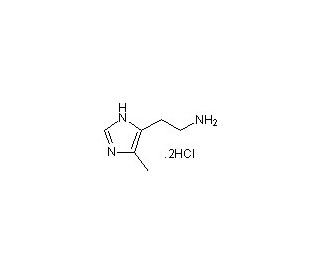

4-Methylhistamine dihydrochloride (CAS 36376-47-3)
See product citations (6)
QUICK LINKS
4-Methylhistamine dihydrochloride, also referred to as 4-MeH, is a synthetic compound that has found extensive application in both scientific and medical research endeavors. Acting as an agonist of the histamine H1 receptor, this compound participates in numerous physiological processes encompassing the regulation of vasodilation, smooth muscle contraction, and neurotransmission. It assumes the form of a white powder, readily soluble in water, and exhibits a melting point of 198-200°C. By functioning as an agonist of the histamine H1 receptor, 4-Methylhistamine dihydrochloride triggers a cascade of events. Upon binding to the H1 receptor, it activates G proteins, thereby initiating subsequent signaling pathways.
4-Methylhistamine dihydrochloride (CAS 36376-47-3) References
- Anxiety and cognition in histamine H3 receptor-/- mice. | Rizk, A., et al. 2004. Eur J Neurosci. 19: 1992-6. PMID: 15078574
- Evaluation of histamine H1-, H2-, and H3-receptor ligands at the human histamine H4 receptor: identification of 4-methylhistamine as the first potent and selective H4 receptor agonist. | Lim, HD., et al. 2005. J Pharmacol Exp Ther. 314: 1310-21. PMID: 15947036
- Compared pharmacology of human histamine H3 and H4 receptors: structure-activity relationships of histamine derivatives. | Gbahou, F., et al. 2006. Br J Pharmacol. 147: 744-54. PMID: 16432504
- Pharmacological characterization of the new histamine H4 receptor agonist VUF 8430. | Lim, HD., et al. 2009. Br J Pharmacol. 157: 34-43. PMID: 19413569
- Histamine inhibits advanced glycation end products-induced adhesion molecule expression on human monocytes. | Wake, H., et al. 2009. J Pharmacol Exp Ther. 330: 826-33. PMID: 19567778
- Histamine inhibits adhesion molecule expression in human monocytes, induced by advanced glycation end products, during the mixed lymphocyte reaction. | Zhang, J., et al. 2010. Br J Pharmacol. 160: 1378-86. PMID: 20590628
- Stimulation of the histamine 4 receptor with 4-methylhistamine modulates the effects of chronic stress on the Th1/Th2 cytokine balance. | Ahmad, SF., et al. 2015. Immunobiology. 220: 341-9. PMID: 25457414
- Regulation of TNF-α and NF-κB activation through the JAK/STAT signaling pathway downstream of histamine 4 receptor in a rat model of LPS-induced joint inflammation. | Ahmad, SF., et al. 2015. Immunobiology. 220: 889-98. PMID: 25666529
- Histamine induces microglia activation and dopaminergic neuronal toxicity via H1 receptor activation. | Rocha, SM., et al. 2016. J Neuroinflammation. 13: 137. PMID: 27260166
- Histamine Induces Microglia Activation and the Release of Proinflammatory Mediators in Rat Brain Via H1R or H4R. | Zhang, W., et al. 2020. J Neuroimmune Pharmacol. 15: 280-291. PMID: 31863333
- Histamine-induced prolactin release: pharmacological characterization of receptors in male rats. | Donoso, AO., et al. 1983. Neuroendocrinology. 36: 436-42. PMID: 6308490
- Comparison of H2 receptor agonists in rabbit atria and aorta. | Tenner, TE. 1981. Pharmacology. 22: 227-34. PMID: 6455672
- Biphasic changes in body temperature produced by intracerebroventricular injections of histamine in the cat. | Clark, WG. and Cumby, HR. 1976. J Physiol. 261: 235-53. PMID: 994032
Ordering Information
| Product Name | Catalog # | UNIT | Price | Qty | FAVORITES | |
4-Methylhistamine dihydrochloride, 10 mg | sc-203475 | 10 mg | $188.00 | |||
4-Methylhistamine dihydrochloride, 50 mg | sc-203475A | 50 mg | $774.00 |