
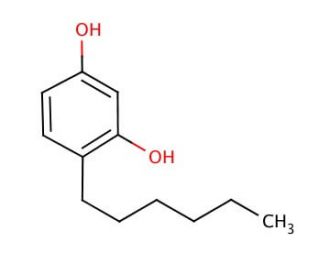

Molecular structure of 4-Hexylresorcinol, CAS Number: 136-77-6
4-Hexylresorcinol (CAS 136-77-6)
See product citations (2)
Application:
4-Hexylresorcinol is a potent irreversible inhibitor of polyphenol oxidase
CAS Number:
136-77-6
Purity:
≥98%
Molecular Weight:
194.27
Molecular Formula:
C12H18O2
Supplemental Information:
This is classified as a Dangerous Good for transport and may be subject to additional shipping charges.
For Research Use Only. Not Intended for Diagnostic or Therapeutic Use.
* Refer to Certificate of Analysis for lot specific data.
QUICK LINKS
Ordering Information
Product Citations
Description
Technical Information
Safety Information
SDS & Certificate of Analysis
4-Hexylresorcinol is an inhibitor of TGase2 (transglutaminase-2) in KB cells. Studies indicate that 4-Hexylresorcinol reduces DNA oxidative damage in human lymphocytes. The combination of 4-Hexylresorcinol and Cisplatin (sc-200896) may act to inhibit tumor growth, cell growth, and KB cell viability. Alternate studies suggest that 4-Hexylresorcinol is a potent irreversible inhibitor of polyphenol oxidase (PPO) activity. Furthermore, 4-Hexylresorcinol is a mixed-type inhibitor which influences the apparent V(max) and K(m) values of the inhibitor by binding preferentially to the oxy form of PPO.
4-Hexylresorcinol (CAS 136-77-6) References
- Browning prevention by ascorbic acid and 4-hexylresorcinol: different mechanisms of action on polyphenol oxidase in the presence and in the absence of substrates. | Arias, E., et al. 2007. J Food Sci. 72: C464-70. PMID: 18034705
- 4-Hexylresorcinol inhibits transglutaminase-2 activity and has synergistic effects along with cisplatin in KB cells. | Kim, SG., et al. 2011. Oncol Rep. 25: 1597-602. PMID: 21424127
- Inhibitory potential of 4-hexylresorcinol against α-glucosidase and non-enzymatic glycation: Activity and mechanism. | Song, S., et al. 2021. J Biosci Bioeng. 131: 241-249. PMID: 33191127
- Effect of 4-Hexylresorcinol on the Efficiency of Antibiotic Treatment of Experimental Sepsis Caused by Antibiotic-Resistant Klebsiella pneumoniae Strain in Mice. | Shemyakin, IG., et al. 2021. Bull Exp Biol Med. 171: 458-460. PMID: 34542762
- An Overview of Alkylresorcinols Biological Properties and Effects. | Zabolotneva, AA., et al. 2022. J Nutr Metab. 2022: 4667607. PMID: 35036005
- 4-Hexylresorcinol: pharmacologic chaperone and its application for wound healing. | Kim, SG. 2022. Maxillofac Plast Reconstr Surg. 44: 5. PMID: 35103875
- Comprehensive interpretation of in vitro micronucleus test results for 292 chemicals: from hazard identification to risk assessment application. | Kuo, B., et al. 2022. Arch Toxicol. 96: 2067-2085. PMID: 35445829
- Effects of 4-hexylresorcinol administration on the submandibular glands in a growing rat model. | Yoon, JH., et al. 2022. Head Face Med. 18: 16. PMID: 35668488
- Administration of 4‑hexylresorcinol increases p53‑mediated transcriptional activity in oral cancer cells with the p53 mutation. | Kang, YJ., et al. 2022. Oncol Rep. 48: PMID: 35856441
- Silicon Doped Carbon Dots as an New Ratiometric Fluorescence Probe for Proanthocyanidins Assay Based on the Redox Reaction Between Cr(VI) and Proanthocyanidins. | Hu, Q., et al. 2023. J Fluoresc. 33: 849-858. PMID: 36595093
- Effect of feeding bioactive compounds identified from plant extracts (4-hexylresorcinol, 7-hydroxycoumarin, and gamma-octalactone) on the productivity and quality of broiler meat. | Zavyalov, O., et al. 2022. Vet World. 15: 2986-2996. PMID: 36718328
- Pectin grafted with resorcinol and 4-hexylresorcinol: Preparation, characterization and application in meat preservation. | Liu, J., et al. 2023. Int J Biol Macromol. 237: 124212. PMID: 36977442
- Effects of Non-Enzymatic Browning and Lipid Oxidation on Color of Ready-to-Eat Abalone during Accelerated Storage and Its Control. | Fan, Y., et al. 2023. Foods. 12: PMID: 37048335
Inhibitor of:
TGase, and TRP1.Ordering Information
| Product Name | Catalog # | UNIT | Price | Qty | FAVORITES | |
4-Hexylresorcinol, 25 g | sc-238860 | 25 g | $70.00 |