
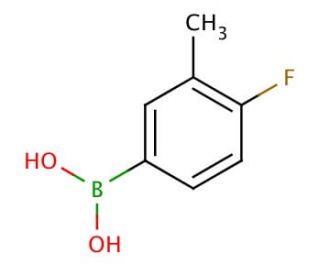

4-Fluoro-3-methylphenylboronic acid (CAS 139911-27-6)
QUICK LINKS
4-Fluoro-3-methylphenylboronic acid is a chemical compound that functions as a boronic acid derivative in development applications. It acts as a key reagent in the synthesis of various organic compounds, particularly in the formation of carbon-carbon and carbon-heteroatom bonds. 4-Fluoro-3-Methylphenylboronic Acid has the functioning to participate in Suzuki-Miyaura cross-coupling reactions, where it serves as a boron source to facilitate the coupling of aryl halides or pseudohalides with organic boronic acids or esters. Through this mechanism, 4-Fluoro-3-methylphenylboronic acid plays a role in the construction of complex molecular structures, enabling the creation of diverse chemical entities for further investigation and study. Its mechanism of action involves the coordination of the boron atom with the palladium catalyst, leading to the formation of an intermediate species that undergoes transmetallation and reductive elimination to yield the desired coupled product. 4-Fluoro-3-Methylphenylboronic Acid′s functional role lies in its ability to serve as a versatile building block for the synthesis of various organic molecules, contributing to the advancement of chemical development.
4-Fluoro-3-methylphenylboronic acid (CAS 139911-27-6) References
- Quantitative structure-activity relationship studies of [(biphenyloxy)propyl]isoxazole derivatives. Inhibitors of human rhinovirus 2 replication. | Kuz'min, VE., et al. 2007. J Med Chem. 50: 4205-13. PMID: 17665898
- Synthetic Studies on Centromere-Associated Protein-E (CENP-E) Inhibitors: 2. Application of Electrostatic Potential Map (EPM) and Structure-Based Modeling to Imidazo[1,2-a]pyridine Derivatives as Anti-Tumor Agents. | Hirayama, T., et al. 2015. J Med Chem. 58: 8036-53. PMID: 26372373
- Synthesis, stability and insecticidal activity of 2-arylstilbenes. | Horty, LG., et al. 2019. Pest Manag Sci. 75: 3015-3023. PMID: 30891871
- Targeted Degradation of SLC Transporters Reveals Amenability of Multi-Pass Transmembrane Proteins to Ligand-Induced Proteolysis. | Bensimon, A., et al. 2020. Cell Chem Biol. 27: 728-739.e9. PMID: 32386596
- Differentiation of Superoxide Radical Anion and Singlet Oxygen and Their Concurrent Quantifications by Nuclear Magnetic Resonance. | Park, J., et al. 2023. Anal Chem. 95: 5293-5299. PMID: 36926848
- Suzuki coupling-based synthesis and in vitro cytotoxic evaluation of C-2 aryl derivatives of Withaferin A. | Ahmad Mir, S., et al. 2023. Steroids. 195: 109246. PMID: 37141979
- Design, synthesis, and antimicrobial activity of novel 5-substituted indole-2-carboxamide derivatives | Mane, Y. D., Sarnikar, Y. P., Surwase, S. M., Biradar, D. O., Gorepatil, P. B., Shinde, V. S., & Khade, B. C. 2017. Research on Chemical Intermediates. 43: 1253-1275.
Ordering Information
| Product Name | Catalog # | UNIT | Price | Qty | FAVORITES | |
4-Fluoro-3-methylphenylboronic acid, 5 g | sc-238843 | 5 g | $69.00 |