
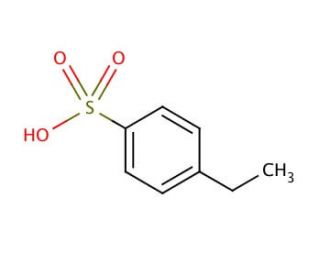

4-Ethylbenzenesulfonic acid (CAS 98-69-1)
QUICK LINKS
4-Ethylbenzenesulfonic acid (4-EBS) is a widely utilized organic acid in laboratory research across various fields. It belongs to the aromatic sulfonic acid group. The versatile nature of 4-Ethylbenzenesulfonic acid enables its application in numerous research areas, encompassing synthesis, mechanism of action, biochemical and physiological effects, as well as advantages and limitations in laboratory experiments. In scientific research, 4-Ethylbenzenesulfonic acid finds widespread usage. Its role as a reagent for the synthesis of various compounds, including esters, amides, and sulfonamides, makes it a common component in organic synthesis. Moreover, it serves as a catalyst in polymer synthesis and the production of other materials. Furthermore, 4-Ethylbenzenesulfonic acid aids in the analysis and determination of compounds like amino acids, peptides, and proteins. Functionally, 4-Ethylbenzenesulfonic acid acts as a proton donor, contributing protons to interact with other molecules through a process called protonation. Protonation plays a pivotal role in biochemical processes such as enzyme catalysis, signal transduction, and protein folding. Additionally, it exhibits acid catalyst properties, enhancing the reaction rate between two molecules.
4-Ethylbenzenesulfonic acid (CAS 98-69-1) References
- Doping effect of organosulfonic acid in poly(3-hexylthiophene) films for organic field-effect transistors. | Nam, S., et al. 2012. ACS Appl Mater Interfaces. 4: 1281-8. PMID: 22288534
- All-polymer solar cells with bulk heterojunction nanolayers of chemically doped electron-donating and electron-accepting polymers. | Nam, S., et al. 2012. Phys Chem Chem Phys. 14: 15046-53. PMID: 23034534
- Production of Biomass-Based Automotive Lubricants by Reductive Etherification. | Jadhav, D., et al. 2017. ChemSusChem. 10: 2527-2533. PMID: 28406578
- Highly stable doping of a polar polythiophene through co-processing with sulfonic acids and bistriflimide. | Hofmann, AI., et al. 2018. J Mater Chem C Mater. 6: 6905-6910. PMID: 30713690
- Increasing the Thermoelectric Power Factor of a Semiconducting Polymer by Doping from the Vapor Phase. | Patel, SN., et al. 2016. ACS Macro Lett. 5: 268-272. PMID: 35614719
- Preparation, characterization, and adhesion of monodispersed polypyrrole particles | A. Zelenev, W. Sonnenberg & E. Matijević. 1998. Colloid and Polymer Science. 276: 838–841.
- Structure and properties of plasma polymerized and 4-ethylbenzenesulfonic acid-doped polypyrrole films | Kouta Hosono, Ichiro Matsubara, Norimitsu Murayama, Woosuck Shin, Noriya Izu, Shuzo Kanzaki. 2003. Thin Solid Films. 441: 72-75.
- Effects of discharge power on the structure and electrical properties of plasma polymerized polypyrrole films | Kouta Hosono, Ichiro Matsubara, Norimitsu Murayama, Woosuck Shin, Noriya Izu. 2004. Materials Letters. 58: 1371-1374.
- The sensitivity of 4-ethylbenzenesulfonic acid-doped plasma polymerized polypyrrole films to volatile organic compounds | Kouta Hosono, Ichiro Matsubara, Norimitsu Murayama, Woosuck Shin, Noriya Izu. 2005. Thin Solid Films. 484: 396-399.
- Improved Performance of Polymer:Polymer Solar Cells by Doping Electron-Accepting Polymers with an Organosulfonic Acid | Sungho Nam, Minjung Shin, Hwajeong Kim, Chang-Sik Ha, Moonhor Ree, Youngkyoo Kim. 2011. Advanced Functional Materials. 21: 4527-4534.
- QSPR study of standard absolute entropies for gaseous organic compounds using novel molecular connectivity indexes and Ring parameter | Lailong Mu a, Hongmei He b. 2011. Thermochimica Acta. 526: 99-106.
- Primary amine-functionalized polyaniline nanothin film sensor for detecting formaldehyde | Sira Srinives a b, Tapan Sarkar a, Ashok Mulchandani a. 2014. Sensors and Actuators B: Chemical. 194: 255-259.
- Synthesis of (hemi)cellulosic lubricant base oils via catalytic coupling and deoxygenation pathways | Basudeb Saha *ab and Dionisios G. Vlachos ac. 2021. Green Chem.,. 23: 4916-4930.
Ordering Information
| Product Name | Catalog # | UNIT | Price | Qty | FAVORITES | |
4-Ethylbenzenesulfonic acid, 25 g | sc-226631 | 25 g | $104.00 |