
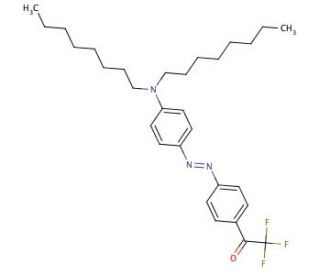

4-(Dioctylamino)-4′-(trifluoroacetyl)azobenzene (CAS 193154-07-3)
QUICK LINKS
The synthetic compound known as 4-(Dioctylamino)-4′-(trifluoroacetyl)azobenzene, or DTAB, has captured the scientific community′s attention for its distinct attributes. Belonging to the azobenzene compound category, 4-(Dioctylamino)-4′-(trifluoroacetyl)azobenzene can undergo reversible photoisomerization upon light exposure. Researchers have extensively examined 4-(Dioctylamino)-4′-(trifluoroacetyl)azobenzene for its potential across materials science and biotechnology.In scientific research, 4-(Dioctylamino)-4′-(trifluoroacetyl)azobenzene has found utility in various applications. It contributes to photoresponsive materials design, aids in creating molecular switches and sensors, and supports the investigation of protein-ligand interactions.Through light-induced reversible photoisomerization, 4-(Dioctylamino)-4′-(trifluoroacetyl)azobenzene transforms its physical and chemical properties. In its trans form, it adopts a planar structure and becomes relatively hydrophilic. Conversely, the cis form is more hydrophobic and displays a bent structure.
4-(Dioctylamino)-4′-(trifluoroacetyl)azobenzene (CAS 193154-07-3) References
- Sol-gel-based optical sensor for the detection of aqueous amines. | Korent, SM., et al. 2007. Anal Bioanal Chem. 387: 2863-70. PMID: 17377784
- Indicator Layers Based on Ethylene-Vinyl Acetate Copolymer (EVA) and Dicyanovinyl Azobenzene Dyes for Fast and Selective Evaluation of Vaporous Biogenic Amines. | Mastnak, T., et al. 2018. Sensors (Basel). 18: PMID: 30544695
Ordering Information
| Product Name | Catalog # | UNIT | Price | Qty | FAVORITES | |
4-(Dioctylamino)-4′-(trifluoroacetyl)azobenzene, 50 mg | sc-238738 | 50 mg | $510.00 |